Gold Breaches 1900, Currency Markets in Holding Pattern
NEW YORK (June 29) In the currency trading arena, there’s been a notable lack of movement today. Gold has caught the market’s attention, sliding past the 1900 psychological level. Yet Dollar remains relatively undisturbed, also showing no significant response to the latest jobless claim data and Q1 GDP final figures. Likewise, the release of higher-than-anticipated German CPI data sparked only a fleeting and mild rally in Euro, lacking subsequent follow-through. Despite today’s tranquil conditions, market participants are bracing for potential turbulence tomorrow, as data releases including China’s PMIs, Eurozone’s CPI flash, and US PCE inflation data are slated.
So far this week, US Dollar and Euro are neck-and-neck in the contest for the strongest currency, with Swiss Franc hot on their heels. Australian and New Zealand Dollars are battling it out to avoid the week’s weakest currency title, though Canadian Dollar may still swoop in and claim that unenviable status. Japanese Yen finds itself in the middle of the pack, trading within a consolidation range, under threat potential government intervention. British Pound is showing signs of weakness, but any significant depreciation is yet to materialize.
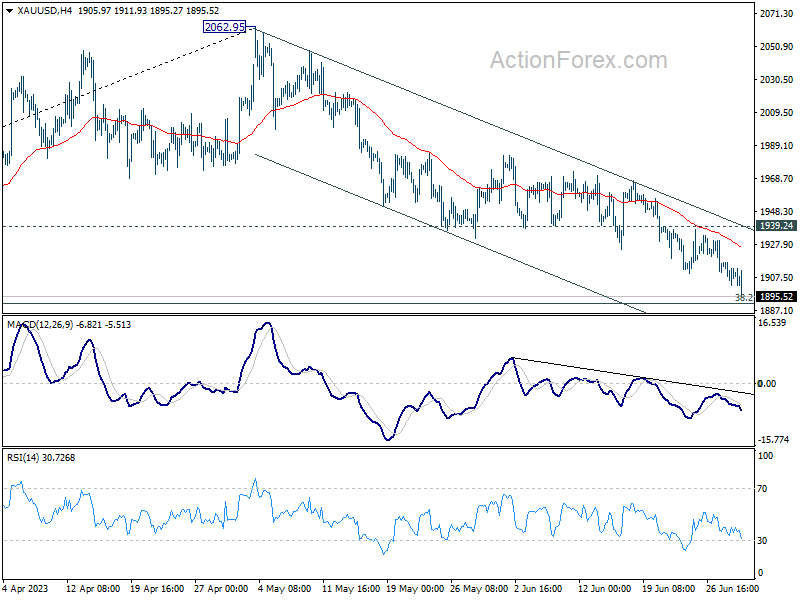
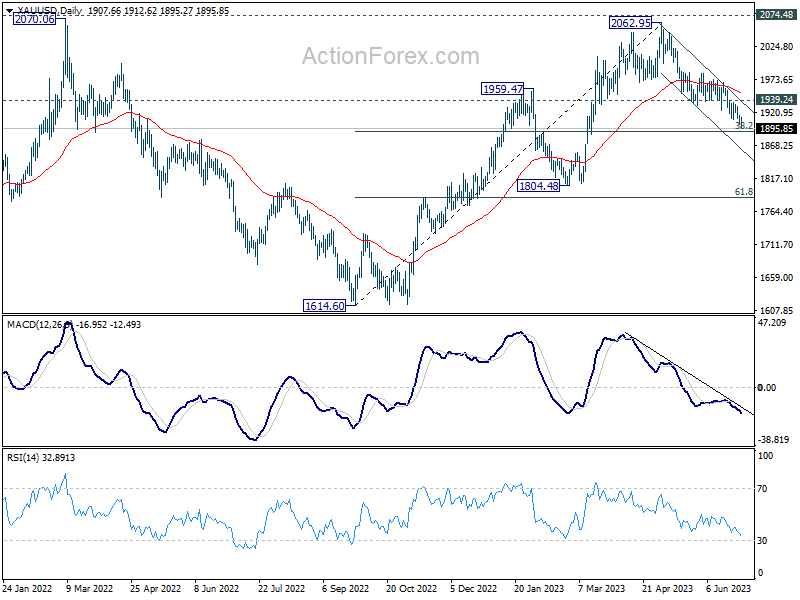
Technically, Gold is now quickly approaching fibonacci support at 38.2% retracement of 1614.60 to 2062.95 at 1891.68. Strong rebound from that level, followed by break of 1939.24 resistance, will be the first sign of bottoming, and keep the decline from 2062.95 as a near term correction only. However, sustained break of 1891.68 would raise the chance of trend reversal. Or, at least that would open up deeper fall to 1804.48, and possibly to 61.8% retracement at 1785.86.
In Europe, at the time of writing, FTSE is down -0.48%. DAX is down -0.03%. CAC is up 0.44%. Germany 10-year yield is up 0.072 at 2.391. Earlier in Asia, Nikkei rose 0.12%. Hong Kong HSI dropped -1.24%. China Shanghai SSE dropped -0.22%. Singapore Strait Times rose 0.06%. Japan 10-year JGB yield dropped -0.0041 to 0.384.
Fed Powell: A long way to go to bring inflation down to 2%
In a speech today, Fed Chair Jerome Powell underscored the ongoing battle with inflation, asserting, “Inflation pressures continue to run high, and the process of getting inflation back down to 2 percent has a long way to go.”
He added that “a strong majority of Committee participants expect that it will be appropriate to raise interest rates two or more times by the end of the year,” referring to the latest dot plot.
Powell painted a mixed picture of the U.S. economy. He noted that “recent indicators suggest that economic activity has continued to expand at a modest pace.” He also pointed to the effects of higher interest rates and slower output growth on business fixed investment.
His comments also highlight the persistent tightness in the labor market. “Over the past three months, payroll job gains have been robust,” Powell said, adding that “labor demand still substantially exceeds the supply of available workers.” Nevertheless, he also observed “some easing in nominal wage growth, and declining vacancies.”
Fed Bostic not seeing urgency to hike again as by others including Powell
Atlanta Fed President Raphael Bostic signaled a more cautious stance on interest rate hikes, contrary to some of his peers’ sentiments. he said, “I don’t see as much urgency to move as stated by others, including my Chair,” expressing his willingness to assess further signs of economic slowdown before advocating for more aggressive action.
Bostic highlighted the fact that Fed has “only been in restrictive territory for 8-10 months”. He is waiting for “more signs that a slowdown is happening in the next several months”.
Nevertheless, Bostic left room for adaptability based on incoming data. He remarked, “If inflation moves away from target or seems to significantly stall out, then we’ll probably have to do more.” However, he also noted that, “We’re not seeing either of those right now.”
US initial jobless claims dropped to 239k, vs exp. 265k
US initial jobless claims dropped -26k to 239k in the week ending June 24, below expectation of 265k. Four-week moving average of initial claims rose 1.5k to 257.5k, highest since November 13, 2021 when it was 260k.
Continuing claims dropped -19k to 1742k in the week ending June 17. Four-week moving average of continuing claims dropped -13k to 1758k.
ActionForex