Gold Price Has More Room To Run
London (Oct 21) We may be due for a short-term correction or continued consolidation in the price of gold. However, the long-term prospect for gold prices is still favorable due to the macroeconomic backdrop. I believe this gold rally is still in the early innings and now is a suitable entry point for those investors who missed the first leg up. Additionally, gold has two tailwinds that will support higher prices - 1) $15 trillion of negative-yielding debt, 2) Foreign Central Bank demand.
Historic Gold Bull Markets
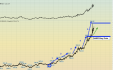
The chart below speaks for itself. In the past three gold bull markets, the price of gold rallied anywhere from 400-700%. The price of gold has rallied only 33% from its December 2015 lows. If this is truly the beginning of a new gold bull market, the price of gold has plenty of room to run and has yet to enter its parabolic stage.
After breaking through key resistance levels at $1,350 in May then $1,480 in early August of this year, the price peaked at the $1,560 handle and has consolidated since August. The last consolidation period occurred between February and June where the price dropped 5% in four months. In this current pause, the price of gold has corrected 4% in two months. Now is a decent entry point for investors who missed the first leg up. Even if the price corrects further to the downside on positive trade war news or strong employment data, the macroeconomic tailwinds still exist.
Tailwind #1: Negative bond yields
The Federal Reserve has kept interest rates artificially low in order to pull future demand to the present and issue government debt at lower rates. Financial repression reached a new milestone when global negative-yielding debt exploded from $5 trillion in 2015 to the current $15 trillion when central banks entered a new easing cycle. Demand for these bonds exists not as a hedge against losses in the price of risk assets, but as a speculative bet on interest rates going into further negative territory.
Any investment guaranteed to lose the investor money is nonsensical. Instead, bond investors are taking part in greater fool theory, betting that rates will go lower before dumping a negative-yielding asset on some “greater fool.” Most of these speculators are not wrong. I, for one, have a substantial TLT position on the assumption that rates in the United States will go to zero or lower.
Low rates is a vicious cycle. Individual, corporate, and sovereign debt all skyrocket when the price of money is effectively zero. Raising rates even slightly will prick these debt bubbles, so the Federal Reserve remains trapped in a zero interest rate policy in order to stave off the human suffering involved in creating the next recession.
Ironically, by kicking the can down the road with even lower rates, they create more inefficiencies and an unstable financial system. Institutional investors, pension funds, and insurance companies have all taken on riskier and less liquid securities in a reach for yield. In fact, an IMF study claimed that in an economic slowdown half as severe as the crisis of 2008, “debt owed by firms unable to cover interest expenses with earnings… could rise to $19tn. That is almost 40% of total corporate debt.”
The main effects of negative-yielding debt are the following: the financial system has become less stable and sovereign bonds are losing credibility as an asset class. Many intelligent investors, including Warren Buffett, avoid gold for being a non-yielding asset. However, a non-yielding asset is a more effective hedge than a negative-yielding asset. The bottom two charts demonstrate how demand for gold rises as the number of negative-yielding sovereign debt rises because investors understand this dynamic.
(Source: Variant Perception - Long-term bull case for gold still intact)
The first chart is simple. The price of gold is closely correlated to the rise in negative-yielding debt. The continuation of the current easing cycle should be a boon for gold prices. The second chart shows historical returns of gold given the real interest rate. The red bar shows the current yield. As the chart suggests, we are a few rate cuts (or higher CPI) away from the -0.5% to +0.5% range where gold has historically provided the greatest returns. Unless the Fed performs another 180-degree turn from dovish to hawkish, the continuation of the easing cycle will be a tailwind for gold prices. With the deterioration of export and manufacturing data due to the trade war, a rate hike or even pause is unthinkable.
Tailwind #2: Foreign Central Bank demand
Slowing economic growth, rising geopolitical tensions, and the desire to diversify away from the dollar have all led Central Banks around the world to bolster their gold reserves. China, India, Russia, and Poland have led the charge in their gold purchases while total global gold demand has risen 8% since 2018.
Global Central Banks will often purchase gold for the same reasons a retail investor will - it serves as a store of value in the face of geopolitical risk or currency devaluation risk. However, the U.S.-China trade war has given countries a third reason to buy gold: decreasing dollar reserves and increasing gold reserves reduce exposure to tariffs and sanctions, thus minimizing Washington’s ability to economically harm countries by taking advantage of the dollar’s status as global reserve currency.
The unraveling of globalization will be one of the most powerful narratives of future financial markets. As global powers seek to create their own trading blocs, de-dollarization will only increase. The Petro-yuan, yuan-denominated futures on the London Metals Exchange, and decreasing dollar reserves held by foreign Central Banks (as seen below as a % of total reserves) all point to a conscious effort to reduce dollar exposure. What will replace these dollar holdings? The increase in current demand suggests gold.
(Source: Wolfstreet.com)
Conclusion
Gold has a market cap of $7.5 trillion. Robust Central Bank demand and $15 trillion of negative-yielding debt (and likely to increase) will push the long-term price of gold higher. Gold remains one of the only undervalued assets in the era of the easy money financed everything bubble. Now that sovereign bonds cannot satisfy investor’s thirst for yield and Central Banks are looking to diversify away the dollar, gold has a chance to go parabolic.
SeekingAlpha