Barometric Indicator Points to October Crash
 share
share
 share
share
 share
share
 share
share
 share
share
What is this ineffable phenomenon we call the cycle? What accounts for its mysterious and ubiquitous, influence over the affairs of men? The all-encompassing cycles are of profound importance to us all since they represent the least common denominator of all temporal existence: time. But what are the causes of this unexplainable energy force which waxes and wanes like the tides of the ocean, yet is powerful enough—in its full force and vigor—to move entire financial markets, bringing them down with the swiftness and severity of a tidal wave or pushing them higher with explosive power? What is the essence behind it?
For over a century the discipline of cycle research has gained its share of adherents, many of whom have desired to discover the mysteries of the cycle and its essential causes. Most walk away perplexed, unable to comprehend the invisible forces that govern the cycle. But others have pressed onward, peering ever-deeper into the inner workings of cycles, determined to find out what it is that makes them tick.
The rewards to those who finally discover its essential cause are manifold. The knowledge of what makes the cycle work would obviously confer many benefits to those who understand and use them to their advantage. Knowledge of this could be applied to the financial markets and great rewards would be reaped. It has been observed that the same cycles that govern the tides of the ocean influence the tides of men. Could there indeed be some connection between the cycles in the natural realm and those in the economic realm? Is the cycle cosmological in nature?
The answer to this question has been taken up by many students of the cycle over the years, and many fine attempts have been made to show some connection between the two. The most respectable of such attempts, in our view, was made in the first half of the last century by a researcher named Edgar Lawrence Smith. His book Tides in the Affairs of Men, now long forgotten except to an informed few, outlines the remarkable discoveries of his cycle research. What Smith accomplished in his work was to prove the correlation between weather and solar events and financial cycles.
In finding a correlation between weather cycles and financial cycles, Smith made a number of intriguing discoveries. He was among the first to document the existence of the recurring decennial cycle in the U.S. stock market, a cyclical phenomenon which can be traced back to the 1800s and still exists. Smith's research also provided corroboration for the 12-month seasonal cycle and the 3 ½ year "Kitchin" or business cycle. Since these recurrent patterns of economic and speculative activity occurred around definite seasonal and cyclical timeframes, he surmised that there must be some larger essential cause behind it.
Here is where Smith's work differs from that of the well-known cycle theorist Jevons, et al. Jevons attempted to show the correlation between solar activity (e.g., sunspot cycles and solar flare eruptions) and weather phenomenon and its subsequent influence on commodity prices, and by extension, stock prices. His work failed, however, to bridge the gap between commodity and stock cycles, especially considering that there are times when bad weather cycles, while exerting a detrimental impact on crop conditions, did not always have the effect of depressing commodity prices in general. What Jevons failed to consider is the large impact that human psychology plays in determining price fluctuations on both the stock and commodity exchanges. Those researchers that had taken this into account never considered that there might be a connection between Jevons' weather and solar cycles and human psychology (rather than simply a direct cause-and-effect influence between weather and prices). Smith's great discovery was that human psychology was the bridge between weather and solar cycles and the markets. Rather than examining the impact of weather upon the markets, Smith examined the effects of weather phenomenon upon the human psyche, and then its effects upon the markets.
Smith, in stating his premise, writes: "While stock price movements are admittedly an incomplete picture, they are possibly of broader general significance than has usually been granted. Our point of view is that to the extent that we are able to discover a ten year recurrent pattern in stock price movements, we are uncovering the effects on mass psychology of some force, yet to be explored, which existed prior to the period of which stock price movements became of themselves so great an influence on general business, and that the movements of stock prices is of significance not only to speculators or investors in common shares but to all men of affairs.
"No one whose activities are affected by mass response can afford to ignore changes in mass psychology. All can profit by a study of whatever may lead to a better understanding of the initiating forces behind its ebb and flow. Commerce, banking and government, itself, must keep this ebb and flow of sentiment in mind, or policies will fail, debts become unpayable, trade, manufacture and labor, all will suffer more than necessary hardships."
At this point, Smith quotes from the physiologist Dr. Ellsworth Huntington, who wrote that "weather cycles affect health, health affects mental attitudes and mental attitudes affect business." He further draws from the voluminous studies of Dr. William F. Petersen, collected in "The Weather and the Patient."—a treatise intended primarily for the medical profession, and covering thousands of case histories in which weather played an important and a measurable part in its effect upon blood pressure, blood chemistry, emotional response and mental attitude, varying in intensity with the temperaments of the individuals considered—but having some effect upon even the most stable of characters. After describing in technical terms many of the changes which take place in the human organism in response to changing temperatures and barometric pressures, Petersen writes:
"As a result, practically every passing atmospheric disturbance involves a period of stimulation for the individual—if infrequent, the individual may become lax; if sufficiently frequent and severe, stimulation may become optimal; if too frequent and too severe, the individual becomes over-stimulated, fatigued; the inadequate individual may succumb."
Petersen concluded: "The effect on the human may vary; in one the reaction time may somewhat delay, in another accelerate the effects. Occasionally, too, individuals may react in contrary fashion as far as some of the physiological mechanisms are involved, but on the whole, the entire population swings in a chemical and physiological rhythm that is identical."
From this starting point, Smith proceeds to outline the basis of this theory. Smith provides as corroborative evidence three charts covering the same time period: one showing the deviation in monthly barometric pressure in New York city; a chart of a pH curve showing changes in the ratio of acidity to alkalinity in the blood stream of numerous persons tested; and the NYSE Composite index, showing the broad trend in stock prices at that time. His findings were astounding. Transposed on top of one another, all three series showed nearly identical movements, with only slight variations in their respective fluctuations. Commenting on Smith's findings, Dr. Petersen wrote: "Off hand I should say that the pH curve certainly coincided with [the] stock market variations…In general, the population is apt to be depressed and blue when the pH is low, and buoyant and energetic and optimistic when the pH curve is higher…This quite coincides…with [the] stock market." The link between blood pH and the stock market, of course, is barometric pressure, a discovery made by Smith.
It is also interesting to note that correlations have also been demonstrated between barometric pressure and volcano and geyser eruptions, tidal activity and even seismic activity. This has been documented by weather experts Nels Winkless and Iben Browning in their book, Climate and the Affairs of Men.
Smith also showed a correlation between rainfall and stock market prices, temperature and stock market prices, and sun spot cycles and stock market prices. The former two (rainfall and temperature) Smith largely discounted since the correlation was weaker than that of barometric pressure and stock market prices. He chose to ignore temperature and rainfall and focus solely on barometric pressure and its effects on human physiology, and by extension, human psychology and the speculative impulse. He also largely ignored sun spot cycles since they are exceedingly difficult to measure relative to weather cycles. He did, however, agree with Jevons in acknowledging that cycles in solar activity were likely the essential cause behind all cyclical affairs on earth, controlling the weather and by extension the economic cycles on the planet.
What Smith found was a direct correlation between the reading of the barometer in New York city and the fluctuations on the New York Stock Exchange. His research was done in 1939. In reading his book, we were intrigued with his findings and wondered whether the relationships he discovered then still held true today. We therefore endeavored to undertake our own investigation into this matter. The results of our research were surprising to say the least. Notice the chart below.
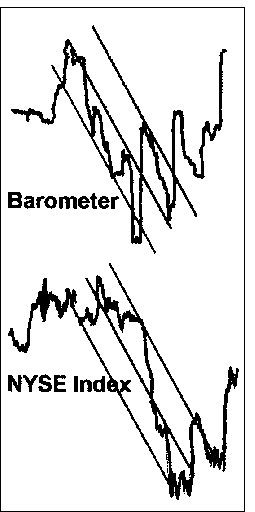
What we found was that there is indeed a direct correlation between barometric pressure in New York and the NYSE Composite index. The barometric readings were taken at the top of every trading hour during the week in New York, along with the corresponding stock market readings. As can be seen from the chart provided here, the barometer led the NYSE at every important turn, especially at bottoms. Notice the trend channels we have drawn for both charts. The slopes of the channels were identical for both series—we merely copied the parameters of the barometer's channel and transposed it onto the NYSE Composite chart without any alteration. When the barometer turned higher and broken out of its downward sloping channel, the NYSE followed suit within a few days. Thus, the New York barometer provides, to some extent, a leading indicator to the NYSE Composite index—long regarded as the broadest measure of trading psychology of the entire U.S. stock market.
Over a period of backtesting, we found that the New York barometer can be used to predict turns in the stock market with an average lead time of one day. We also found a series of definite cycles that controlled the barometer's fluctuations—much as one would expect to find in the stock market itself. We also noted conspicuous seasonal tendencies in the barometer. For instance, there are times during the year in which barometric pressure shows sudden changes in trend, namely between major seasons. These changes are punctuated by extremely volatile movement. The time of year in which the barometer typically shows the most pronounced movement is none other than October—the time of year most commonly associated with downward movement in the stock market. We attribute this, based on our empirical research, to the large shifts in barometric pressure as summer-like weather gives way to winter-like weather. This would be expected to cause changes in human blood chemistry—and by extension human psychology—which in turn influences trends and trading patterns on the stock exchanges.
While the numerical science behind this method of combining barometric indications with stock market fluctuations is admittedly infant, we have come to discover several seemingly ironclad rules for interpreting this relationship. Among them: 1.) Whenever the barometer in New York is above 30.05 and rising, it is normally bullish for the NYSE Composite, at least in the very short-term. In fact, any reading above 30.05 generally means the market is stable and will not suffer any serious decline. 2.) A reading of below 30.05 and falling is typically bearish for the NYSE over the very near-term. The more prolonged and pronounced the decline in barometric pressure, the more significant the drops in the overall stock market tend to be. For instance, over a three-day period last week (Oct. 9-11), the barometer in New York declined considerably from a reading of 30.29 to a low of 29.77. Within two days of this decline, several leading stocks took nasty drops in share price, even to the extent of outright crashing in some case. This had the effect of causing the NYSE Composite to drop to its lowest level in several months. By Thursday, however, the barometer witnessed a quick recovery to a reading of 30.29. The following day saw the Dow Jones Industrials, NASDAQ Composite and NYSE Composite all stage impressive rallies.
Looking at a longer-term chart of the barometer, however, yields several important indications that overall barometric pressure is dropping. In recent weeks, the barometer has etched out consistently lower highs and appears to have begun a downward trend that will likely carry atmospheric pressure readings to seasonal lows. This weakness in the barometer could be seen even at this writing (Oct. 16). This dovetails perfectly with our forecast for a major stock crash in the latter part of October with severe weakness continuing into November. Barometric pressure in recent months has led every significant drop in stock prices. We do not expect this time to be any different.
We have not space to examine all of Smith's important findings concerning the relation between weather cycles and financial cycles. We would point you to his important, if overlooked, book (available from Fraser Publishing, www.fraserbooks.com). The important thing to emphasize is that there is a definite correlation between weather and financial cycles, the former leading the latter. Influencing both are solar cycles, a subject that is only now being examined with the depth and scope it deserves. For now, we will content ourselves with knowing that changes in the weather have measurable impacts on human psychology, which in turn influences price fluctuations in trade and commerce. All of this brings us yet another step closer to discovering the essence of the financial cycles we follow in our trading.
Clif Droke is editor of the weekly Leading Indicators newsletter, covering the U.S. equities market outlook from a technical perspective as well as the general economic outlook. He is the author of the recently published book, Technical Analysis Simplified. For a free sample issue of Leading Indicators, send name and mailing address to [email protected] or mail to: Leading Indicators, 816 Easely St., #411, Silver Spring, MD 20910.
share
share
share
share
share