Dollar Holds Gains on Policy Split; S&P 500 Breaks 2,000
New York (Aug 25) The dollar maintained gains versus major peers as signs of divergence in U.S. and euro-area monetary policy fueled a surge in European bonds. Asian index futures were mixed after the Standard & Poor’s 500 Index touched above the 2,000 level, while crude oil held declines.
The greenback was at $1.3188 per euro by 7:32 a.m. in Tokyo, after yesterday reaching an almost one-year high, while the yen and New Zealand’s dollar traded near their weakest levels in at least six months. New Zealand bonds climbed after yields on two-year German notes dropped below zero. S&P 500 futures were little changed after the gauge ended the U.S. day up 0.5 percent to 1,997.92, reaching 2,001.95 for the first time during the day. Japanese index futures retreated in Chicago while oil in New York was steady near a seven-month low.
Investors revisited central bankers’ speeches at last week’s symposium in Jackson Hole, Wyoming, where European Central Bank President Mario Draghi signaled he may boost stimulus, while Federal Reserve Chair Janet Yellen hinted the timeline for interest-rate increases could be brought forward. The presidents of Russia and Ukraine are set to meet in Minsk today, amid Russian plans to send a second convoy of aid trucks after the first sparked accusations of an invasion.
“The weekend’s gathering of global central bankers at Jackson Hole has reinforced the different challenges facing major economies at present, and endorsed the view of a stronger U.S. dollar,” Garry Dean, a sales trader in Auckland at CMC Markets, wrote in an e-mail. Yellen’s comments were “less dovish than expected, and traders seized on her comments that rates may need to rise sooner than expected if the labor market recovers faster than anticipated.”
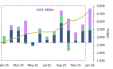
Dollar Index
The euro weakened as much as 0.4 percent last session to $1.3184, the lowest level since Sept. 9, 2013, as the Bloomberg Dollar Spot Index, which tracks the greenback against 10 major peers, climbed 0.2 percent to its highest close since Jan. 31.
The yen was little changed today at 104.06 per dollar, after dropping 0.1 percent yesterday, its sixth day of decline and the longest slump this month. Japan’s currency reached as low as 103.86, the least since Jan. 23. The kiwi lost 0.2 percent to 83.30 U.S. cents following yesterday’s slide of as much as 0.9 percent to the lowest level since Feb. 27. New Zealand posted a wider-than-expected trade deficit in July, fueling kiwi declines, data today showed.
Yields on 10-year New Zealand government bonds fell one basis point, or 0.01 percentage point, to 4.22 percent in early trading today.
German Notes
Rates on Germany’s two-year notes slid three basis points yesterday to minus 0.034 percent, after earlier touching 0.046 percent, the lowest yield since 2012. Belgian two-year bond yields fell to an all-time low, while 10-year Italian rates slipped 10 basis points to 2.48 percent. Similar-maturity Spanish notes yielded as little as 2.214 percent yesterday.
Draghi said in his speech at the Fed Bank of Kansas City symposium in Jackson Hole Aug. 22 that investor bets on euro-area inflation “exhibited significant declines at all horizons” in August. European policy makers “will use all the available instruments needed to ensure price stability over the medium term.”
Ten-year U.S. Treasury yields dropped two basis points to 2.38 percent in New York. The notes offered the highest yields over similar maturity German bunds in 15 years.
Nikkei 225 Stock Average futures dropped 0.1 percent to 15,585 on the Chicago Mercantile Exchange after gaining 0.3 percent in the previous session. Contracts on the index traded in Osaka fell 0.1 percent to 15,600 by 3 a.m. local time. The stock gauge rose 0.5 percent yesterday amid the weaker yen, helping the MSCI Asia Pacific Index (MXAP) end the day up 0.1 percent.
Qihoo Slips
Futures on Australia’s S&P/ASX 200 Index climbed 0.1 percent in most recent trading, while contracts on the Kospi index in Seoul were unchanged at 265.40. Contracts on Hong Kong’s Hang Seng Index were up 0.1 percent as futures on the Hang Seng China Enterprises Index ended their most recent session little changed. The Bloomberg China-US Equity Index of the most-traded Chinese stocks in New York rose 1 percent.
Qihoo 360 Technology Co., owner of China’s second-largest online search engine, slipped the most this month in New York after saying operating margins shrank in the second quarter, while operating expenses more than doubled.
Deals activity buoyed U.S. stocks, with Burger King Worldwide Inc. soaring more than 19 percent amid its talks to buy Tim Hortons Inc. in a tax-saving move. InterMune Inc. surged 35 percent after Roche Holding AG purchased the biotechnology company for $8.3 billion. Morgan Stanley climbed to the highest since 2009 and JPMorgan Chase & Co. and Goldman Sachs Group Inc. added at least 1.3 percent for the biggest gains in the Dow Jones Industrial Average.
Dot-com Memories
By breaching the 2,000 level, the S&P 500 is building on its rally with a velocity approaching the strongest stretch of the 1990s dot-com bubble. Investors who owned the index when the advance began March 9, 2009, are sitting on price appreciation of 195.5 percent, or an average of 24.5 percent a year, according to data compiled by Bloomberg. That compares with a gain of 236 percent, or 27.1 percent annually, over an equal amount of days ending March 24, 2000.
Similarities to the technology-fueled gains of two decades ago are multiplying with the bull market approaching three years without a decline of 10 percent or more. In one respect, the two periods are different. The dot-com bubble peaked with the S&P 500 trading at close to 30 times annual earnings of its companies, while the valuation is about 19 times now, data from S&P Dow Jones Indices show.
‘Psychological’ Level
“2,000 is a pretty significant number from psychological and financial points,” Joe Bell, senior equity analyst at Cincinnati-based Schaeffer’s Investment Research Inc., said by phone. “We’re seeing the continuation of a strong momentum that occurred in July. Perhaps we might reach a little bit overbought status, and it looks like the index is going to take a breather there.”
Data yesterday showed the pace of new-home sales in the U.S. fell to the slowest in four months in July. Housing has advanced in fits and starts this year, buffeted by tight credit and slow wage growth.
Russian President Vladimir Putin is scheduled to meet with Ukrainian President Petro Poroshenko today, during trade talks in the Belarusian capital. European Union representatives will be present at the talks, which are aimed at finding some kind of respite to a conflict that the United Nations says has left at least 2,000 dead since Putin annexed the Crimean peninsula in March.
Copper, Oil
Russia plans to send a second convoy of trucks loaded with humanitarian aid to Ukraine, Foreign Minister Sergei Lavrov said yesterday, after the first delivery sparked international condemnation by crossing the border without authorization. Russia is the world’s largest energy exporter.
Copper futures on the Comex lost 0.1 percent to $3.2380 a pound, with trading on the London Metals Exchange to resume today after yesterday’s U.K. holiday. Gold was little changed at $1,276.26 an ounce in the spot market after dropping 0.3 percent yesterday, extending last week’s 1.8 percent decline.
West Texas Intermediate crude oil was steady at $93.36 a barrel after falling to its lowest close since January last session. Trading on the Globex platform of CME Group Inc., the world’s largest futures market, was halted for about four hours yesterday, suspending contracts from oil to stocks and commodities. Brent crude oil rose 0.4 percent to $102.65 a barrel yesterday.
U.S. crude stockpiles at the Cushing, Oklahoma, hub probably rose for a fourth week, data this week may show, according to energy analysts surveyed by Bloomberg. Islamist militias also seized the international airport in Tripoli, Libya.
Source; Bloomberg