Fundamental View on Metal Markets


The resource industry and market review I have prepared are the result of several queries from investors and associates in the past few months about my feelings and beliefs regarding the current debacle and what the future holds. Unfortunately, most of us will be affected on one level or another.
It is my belief that the world always or ultimately operates on the fundamentals of supply and demand. To reinforce this, my understanding of the demand from the BRIC (Brazil, Russia, India and China) countries has always remained positive. These countries will continue their modernization regardless of the recession we are experiencing in the West.
That leaves the supply side - the question is: What has been happening to disrupt the supply of metals? Taking a cross-section and focusing on mine shutdowns and cut-backs in production, I had two huge surprises. First, I was astounded by the proliferation of new producers in the past 1 – 3 years. Second, I am shocked by the rapid response to the downturn reflected in the number of recent production shutdowns. Over the past few weeks, while conducting research for this piece, the number of shutdowns has accelerated considerably.
Also, major small and mid size producers are cutting back their production in all metals. The immensity of that combined extinguished supply demonstrates that a tilt in the supply/demand equilibrium is just around the corner and a spike up in commodity prices is not far behind.
In 2003, I conducted a supply-and-demand analysis for molybdenum. As a result I moved to create a pure molybdenum company and to achieve the advantage of a head start towards production.
I have been involved in the stock market and the mining industry for the past 45 years. In that time, I have never experienced such a terrible meltdown in the markets. Even the stagflation of the 1970’s would be welcome at this point in time. The value of my mining stocks during the mid to late 70’s neither went up nor down but remained at pretty much the
same prices, as compared to today where my portfolio is down by 80% to 90%. Although most markets have lost 60% to 80%, resource stocks particularly, have been hit hard. My entire working life has been in the resource sector, so that will be the focus of this editorial.
The majority of the forecasters on commodities today are predicting a several-year bear market in the prices of metal commodities across the board. My fundamentalist point of view, resulting from hands on research, is the exact opposite of the popular consensus for several reasons:
- The world-wide recession is well into its second year. I believe a financial meltdown scenario has been averted for the interim and once the new U.S. government is installed (or its direction is made known) markets will establish or have already hit a bottom from which to build.
- The U.S. and European economies are being vigorously re-inflated.
- Commodity prices have fallen too far too fast.
- The shut down of several coal-fired power generating plants in China during the Olympics contributed to the metal price collapse. The shutdowns sidelined demand and led to the stockpiling of metals, (This put China in the driver’s seat on negotiating long-term metal contracts, especially in iron and coal) for a five month period, a lot of primary industry in China was cut to 50% capacity. The commodity demand was weakening and I believe the final blow was the planned slow down in China which helped accelerate the downturn, certainly a one time event. Definitely a huge long-term benefit for China.
- Forced liquidation of commodities by commodity traders again compromised the stability of the supply/demand factor of metal commodities. LME traded commodities, especially copper, will take longer to rally due to the heavy manipulation by funds, whereby much larger stockpiles existed than were apparent.
- More producers are currently operating at or below their cash cost. Those companies with large debt are being forced to shut down their marginal operations. The reaction to this sudden market downturn by producers has been to shut down, curtail and reduce production of copper, aluminum, iron, nickel, zinc, lead, manganese, uranium, molybdenum, cobalt, tantalum, etc. Even the market for raw diamonds has shown a significant drop in price. This has been immediate and I believe it will result in a faster recovery of the prices for these commodities.
- Literally hundreds of small to medium producers worldwide, in all categories, have been forced to shut down production of metals. Some of these producers will not re-open.
- China will be stimulating its economy with a package amounting to $600 billion U.S. over the next three years. I believe the first beneficiary will be the steel industry which will lead the way out of the recession in base metals. The first steel related metals to recover will be molybdenum, cobalt, manganese, tungsten, niobium and chrome.
- Dozens of mining projects slated to begin construction have been postponed indefinitely.
- Infrastructure replacement and expansion to be implemented in Western countries, particularly in the United States.
- Yunnan province in China has announced a one million tonne purchase of commodities for stockpiling namely, copper, aluminum, lead, zinc and tin a $3 billion dollar investment. The central government is also looking to stockpile all metals as a result of low prices. This would be a wise move to convert U.S. dollars into tangible assets. (Beginning to see a trend here?)
I have been steadfast in my belief that all commodities are strictly governed by supply and demand with the exception of LME-traded metals which are heavily influenced by speculators, funds and large investor trading. My theory about a bounce-back in metals was reinforced when researching a large cross-section of current and near-term producers, in conjunction with a list of several operators now on care and maintenance which currently influence or could influence the supply of all categories of metal. For those of you interested, I have compiled a list of companies which currently have some of their mining operation on care and maintenance that may be obtained from: www.reacompanies.com/list. This list is only the tip of the iceberg of what is happening in our industry and focuses only on North American listed stocks where the situation here at home is only a reflection of what is happening worldwide. The total analysis involved over 100 companies but I have only listed those companies which have actually shut down or those that have put some of their mining operations on care and maintenance. Remember, this is only a glimpse what is happening out there.
Due to safety regulations, China alone will be shutting down 6,000 of its 16,000 coal mines over the next 2 years. Forty-five out of seventy-five copper/ cobalt producers have shut down in the Democratic Republic of Congo (DRC). Shut downs are also widespread in Australia, South Africa, South America and India, etc.
To me, the conclusion is obvious - those companies which have recently commenced production or have advanced projects on stream to go into production are being severely punished by the market with some market caps decreasing as much as 90% to 99%. There is no avenue for them to raise money to streamline operations in order to turn the corner on new production. At the present market stage bridge loans are a particularly difficult scenario with which to deal and any company having to repay those bridges is at severe risk of failure. It is a ‘damned if you do and damned if you don’t’ scenario. My sympathies go out to those companies as I understand the hard work and focus required to bring on new production today. The old adage of having production to see you through the lean times has not held up this time around for a vast number of companies and appears to be a liability rather than an asset for most of them. The above list reflects only 20 companies which have shut down production – to think of the total number boggles the mind.
The entire resource sector has been ravaged with the share prices of junior explorers down 95% to 99%, intermediate producers down 60% - 90% and some majors down close to 85%, especially in the steel industry. The total resource sector has had approximately $1.5 trillion knocked off of its market cap, with household names like U.S. Steel losing 85% of its market cap in the past 6 months.
In my opinion, the way all categories of mining stocks are now viewed by the investment bankers and the investment community will change radically as follows:
- Geopolitical risk will become a major factor whereas a year ago it was not heavily considered in the investment strategy.
- Bridge loans are now considered toxic by the investment community and no one is stepping up to re-finance even good projects especially those exposed to bridge loans.
- Bond issues and debt financing are impossible and probably should not be pursued at this time.
- Obviously, most of the advanced-stage projects have been rendered unfeasible at current commodity prices.
- Overwhelming reluctance to do equity financings at this point in the market.
- Feasibility Studies by new producers will have to be economical at close to current commodity prices.
- Close attention will be focused on strip ratios, continuity of deposits, bulk testing, proven metallurgy and road access.
- Mergers and acquisitions will only occur between strong companies. In this market weak companies will tend to bring down the strong company. The take-over candidate must be able to generate the price of the acquisition.
- Balance sheets will be scrutinized and, companies having large debt loads will be evaluated on their ability to continue servicing that debt. Companies cannot service debt when they are losing money.
- Companies with large commitments will face tougher evaluations.
- Financings will get back into a selective positive mode once commodity prices move up significantly from today’s lows.
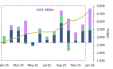
The following is a snapshot comparison of some of the commodity price losses in the past 6 months:

Through previous observation and current research I have identified certain trends which indicate that prices will again head north in the next 6 – 18 months and eventually break most historic highs. This commodity Bull will break all previous cycles as the BRIC countries continue to modernize their. The massive amount of metal supply that has been extinguished in the last 6 months will very quickly have a positive effect on metal commodity prices once again.
Some of the benefits derived from the financial meltdown are as follows:
- Cheaper cost of production as fuel, replacement machinery, power, transportation, floatation additives and consumables go down in price.
- Drilling and exploration infrastructure costs will go down. Drilling companies are now readily available.
- Availability of geologists, mining engineers and engineering firms is now prolific.
- Availability of large mining and milling equipment is readily accessible. Lead-time is dramatically reduced.
- Experienced mining and milling personnel are now available as tens of thousands are being laid-off. I have pretty much focused on base and minor metals in my review and it goes without saying that precious metals have a similar driving force and are experiencing closures as well. With gold being the exception, silver, platinum and palladium have a solid industrial base and will follow the direction of the base metals. Conversely, gold is the ultimate currency and will lead all metals out of this current recession. The disconnect between gold and other precious metals will become more evident going forward. My observation is that gold will play a much more important role as we become awash in all the world’s currencies and seek value that cannot be destroyed by banks or governments.
I believe the deck is stacked in favor of all commodities, surviving mining companies and explorers over the next three years. We will look back on the last two months of 2008 as the greatest buying opportunity of the century.
My exercise in the synopsis outlined above was to source a course of action to direct my companies over the next 2 – 5 years. I am more enthused now about the prospects for our industry than I have been in the last 18 months. Caution is the direction I choose for the interim and as the market signals, I plan to become more aggressive in the future.
I believe the shareholders deserve to know how their management and directors intend to move forward during these tumultuous times so I will be posting my observations on our website: www.reacompanies.com
In conclusion, I personally have been investing and continue to invest at these dramatically lower prices. Due to the current market my retirement has been postponed several years and I believe the only way I will be able to recoup is to take advantage of the current low share values. This is the tax selling season which creates further discounts from current low prices, definitely an advantage to the contrarian buyer. Look for companies that will survive the current market as these companies will be the strongest emerging from this recession. It’s a new world out there but the emerging economies need our products. Daily, more and more casualties are appearing in our industry and this will continue until well after commodity prices once again head north.
Mines can not operate at losses so supply will diminish much faster in this cycle, once more creating runaway prices in the next leg of the commodity Bull market.
I encourage everyone to do their own due diligence as there are great opportunities in the market today with excellent projects, low-cost production and don’t forget the junior companies that are trading at less than cash value.
From time to time, I’ll be updating this article, and if you’d like to receive those updates, please send an email to: [email protected]