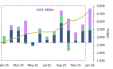
US Dollar On The Back Foot
New York (Mar 27) We’ve now heard from all the major central banks and the overall message is fairly consistent: monetary policy is set to continue to be accommodative no matter where you look in the world. Less than a fortnight ago the European Central Bank (ECB) unleashed another blast of stimulus, surprising the markets with its ferocity. Last week the Bank of Japan held back from further monetary easing but the bank’s governor subsequently made it clear that there was no reason why the negative interest rate adopted at the end of January couldn’t be lowered further, perhaps to -0.5% from its current -0.1% level. Then on Wednesday the US Federal Reserve kept its benchmark lending rate steady between 0.25% and 0.50%, after raising it by 25 basis points in December. This was expected. However, they also dialed back on how much they envisage raising short-term interest rates in 2016 and beyond, noting that the global outlook continued to “pose risks” as did financial market volatility. The news led to a dramatic sell-off in the dollar and sharp rises in precious metals and other dollar-denominated commodities. It wasn’t long before equities also joined in the broad-based “risk-on” rally which saw the major US indices trade back up to levels not seen since the end of last year.
So this loose monetary policy is certainly having a positive effect on risk markets. But what does it tell us about the state of the world’s economy? As noted above, the Fed’s FOMC expressed concerns over global growth and financial market volatility. Surely it’s sensible to be cautious when one considers that seven years on from the nadir of the financial crisis (when the S&P 500 hit that infamous intra-day low of 666) central banks are still providing monetary stimulus and have taken the extraordinary step of adopting negative interest rates? What’s more, the Fed does seem to be in a bit of a bind. Many analysts questioned the wisdom of the December rate hike when a number of critical indicators (in particular Manufacturing PMIs) were contracting and trending lower. But this time round others are asking the Fed why it has slashed its projections for future hikes when its employment goal has been met and, depending which measure one uses, inflation is at or closing in on its 2% target. Core PCE – which is the Fed’s preferred inflation measure – is now around 1.7% while on Wednesday Core CPI came out at +2.3% annualised. Fed Chairman Janet Yellen was asked about this and what it said about the central bank’s credibility in her post-statement press conference. Her reply was incomprehensible.
SOURCE: iNVESTING.COM