Dollar Poised for Longest Rally Since 1967 on Divergence
Washington (Sept 19) The dollar headed for its longest stretch of gains since Lyndon Johnson was in the White House after the Federal Reserve signaled an end to unprecedented monetary stimulus measures next year.
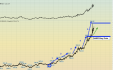
The U.S. Dollar Index advanced for a 10th straight week, the longest since at least March 1967, when Johnson was in the fourth year of his presidency. The yen fell to a six-year low as the Bank of Japan pledged to maintain stimulus to stave off deflation, and the euro reached the weakest in 14 months as the European Central Bank offered a loan program. Sterling rose for the first week this month after Scotland rejected independence.
“The dollar is the No. 1 trend across all asset classes going into the end of the year,” Neil Azous, founder of Stamford, Connecticut-based research firm Rareview Macro LLC, said in a phone interview. “It’s back to trading interest-rate fundamentals.”
The U.S. Dollar Index, which Intercontinental Exchange Inc. uses the gauge to track the greenback against the currencies of six U.S. trading partners, increased 0.5 percent to 84.753 at 2:51 p.m. New York time. The gauge touched 84.783, the highest since July 2010, headed for a 0.6 percent gain on the week.
The dollar climbed as much as 0.7 percent to 109.46 yen, the highest since August 2008, before trading at 108.97 yen, up 0.3 percent. It has gained 1.5 percent this week. The greenback appreciated 0.7 percent to $1.2835 per euro, 1 percent stronger on the week. It reached $1.2831, the highest since July 2013. The euro declined 0.4 percent to 139.86 yen.
‘Coiled Spring’
“It tells you the dollar has been so depressed over the last few years, and now that depression is unwinding, like a coiled spring,” Douglas Borthwick, head of foreign exchange at New York brokerage Chapdelaine & Co., said by phone. “The Dollar Index will continue to stay bid as long as the Japanese continue to make motions of quantitative easing while Europe makes more noise about expanding their balance sheets.”
Currency-market volatility declined for a fourth day. JPMorgan Chase & Co.’s Global FX Volatility Index slipped to 7.29 percent, the least since Sept. 8 on a closing basis. It rose to 7.65 percent on Sept. 15, the highest since April 1. The average this year is 6.87 percent.
Fed policy makers, who met on Sept. 16-17, increased their median estimate for the federal funds rate to 1.375 percent at the end of next year, versus June’s forecast for 1.125 percent. The benchmark target rate has been in a range of zero to 0.25 percent since 2008 to support the economy.
Fed Bets
There’s a 59 percent likelihood the U.S. central bank will raise the rate to at least 0.5 percent by July 2015, futures trading data compiled by Bloomberg showed. That’s up from a 49 percent chance a month ago.
The ECB loaned 82.6 billion euros ($106.5 billion) to euro-area banks yesterday at a fixed interest rate of 0.15 percent in the first of its targeted longer-term refinancing operations. The so-called TLTRO is among a package of measures ECB President Mario Draghi said will boost the bank’s balance sheet by as much as 1 trillion euros to spur a slumping economy.
The U.S. Dollar Index has rallied 5.9 percent this year, set for the biggest annual gain since 2008, when the Fed began the first of three rounds of bond purchases under the quantitative-easing stimulus strategy. The gauge lost 4.2 percent in 2009.
The yen dropped this week against most major counterparts after Bank of Japan Governor Haruhiko Kuroda said in Tokyo he won’t hesitate to adjust policy if needed. The central bank retained a pledge at a gathering this month to increase the monetary base at an annual pace of 60 trillion yen ($550 billion) to 70 trillion yen. It next meets on Oct. 6-7.
Scotland Vote
The dollar has risen 3.1 percent in the past month in a basket of 10 developed-nation currencies tracked by Bloomberg Correlation-Weighted Indexes. The yen has lost 3.2 percent, the biggest decline, and the euro has fallen 1 percent. Sterling has gained 1.1 percent.
The pound strengthened after the outcome of the independence referendum was announced. Scotland saw a record turnout of more than 90 percent in some regions.
“The global markets’ confidence in the U.K. economy will likely be restored and regenerate demand for domestic companies and assets,” Neil Jones, the head of hedge-fund sales at Mizuho Bank Ltd. in London, said in an e-mailed comment. “The long-run pound-appreciation trend should continue.”
The pound advanced 0.1 percent to 78.70 pence per euro after appreciating to 78.10 pence, the strongest since July 2012. It has gained 1.2 percent on the week, the most since June. Sterling jumped 0.8 percent to $1.6525, the highest since Sept. 2, before trading at $1.6313, down 0.5 percent, trimming a weekly gain to 0.3 percent.
Soiurce: Bloomberg