Republicans Asserting Reliance on Gold as World Loses Confidence: Paul Ryan
As the price of gold hit new highs following the 2008 financial crisis, Republicans saw the yellow metal’s steady ascent as a sign of troubNew York (Nov 14) le ahead.
To Representative Paul Ryan of Wisconsin, record gold prices in 2010 heralded “a lower standard of living for many Americans.” Representative Ted Poe of Texas foresaw “a blast of inflation that will crush the middle class” adding: “Where gold prices go, other prices follow.” Fellow Texas Representative Ron Paul, a perennial critic of the Federal Reserve, warned that “confidence is being lost in the entire fiat monetary system,” a reference to money created by central banks.
The Republicans’ confidence in gold as an economic and financial barometer proved ill-founded. Five years after the crisis, the dollar’s value measured against the currencies of major U.S. trading partners is little changed. Prices have risen at an annual 1.4 percent rate, less than half the 50-year average and lower than the Fed’s 2 percent target.
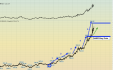
By July, gold had slid 36 percent from its September 2011 high of more than $1,900 an ounce, the steepest percentage decline since prices plunged by 58 percent over 21 months ending in June 1982.
Sound Dollar
So far this year, 52 lawmakers lined up to cosponsor Texas Representative Kevin Brady’s “Sound Dollar Act,” which would require the Fed to keep prices stable by monitoring a variety of assets, including gold, and by tracking “the value of the United States dollar relative to gold.”
Republican Senator Mike Lee of Utah introduced similar legislation in February. Neither bill has been acted upon.
“It’s a stupid idea,” Joseph Gagnon, a former Fed economist, said in an interview. “It’s pretty clear the Fed thinks so, too, since they do the opposite. They go out of their way to exclude commodities.”
Gagnon, now with the Peterson Institute for International Economics in Washington, says the Fed tracks most closely “core” inflation readings that exclude often-volatile commodities.
Ryan, chairman of the House Budget Committee, also has been among Republicans who’ve suggested the Fed should peg the dollar to a “basket of commodities” that would include gold.
Eliminating Taxes
In April, three days after gold completed its worst two-day decline in more than 30 years, Lee, joined by Senators Ted Cruz of Texas and Rand Paul of Kentucky, proposed legislation to eliminate taxes on gold and silver currency declared legal tender by federal or state governments. The measure would effectively allow the metals, now taxed at sale as collectibles, to serve as alternative currencies.
Spokesmen for Brady, Ryan, Lee, Cruz and Paul declined to comment. Poe’s office didn’t respond to requests for comment.
Rich Danker, director of economics for the American Principles Project, a Washington-based organization that advocates smaller government and free markets, calls legislation such as Lee’s a “prerequisite” for a return to the gold standard, which his group supports.
Danker dismissed gold’s recent decline. “The gold standard has never been about the floating price of gold,” he said. “Gold’s long-term value has always been steady. There’s no reason to think that would change over hundreds of years.”
19th Century
The idea of anchoring U.S. currency to a precious metal dominated economic debates in the late 19th century with factions dueling over the use of gold, silver or both. Since the Democratic Party split in 1896 between the pro-gold incumbent President Grover Cleveland and his intra-party rival William Jennings Bryan, gold has been almost entirely a Republican obsession.
“I can’t think of any Democrat who’s for it,” said Richard Grossman, economics professor at Wesleyan University in Middletown, Connecticut, and author of the book “Wrong: Nine Economic Policy Disasters and What We Can Learn From Them.”
President Franklin D. Roosevelt, a Democrat, took the dollar off the gold standard in one of his first moves to combat the Great Depression in 1933. President Richard Nixon, a Republican, broke the last link to gold in August 1971, ending the ability of foreign central banks to convert dollars into a fixed quantity of the metal.
‘QE Infinity’
In a November 2012 speech to an APP conference, Cruz, a Tea Party favorite, assailed the Fed’s $85 billion in monthly asset purchases -- an economic stimulus program known as quantitative easing -- which he says puts the dollar at risk.
“We’re in the middle of QE infinity right now,” he said. “And when you see the currency debased, it is a cruel tax on everyone working and struggling and saving. As we’ve seen gold skyrocket, and we’ve seen oil skyrocket, we’ve seen food skyrocket, we’ve seen the cost of living for those struggling to climb the economic ladder get higher and higher and higher.”
Gold fans bemoan the dollar’s loss of purchasing power in terms of how much gold it will buy, though that hasn’t affected the cost of living. Since December 2008, the consumer price index has risen at an annual rate of 1.6 percent, compared with 2.8 percent during the 2001-2009 Bush administration.
Bernanke Stumped
The meaning of gold price movements remains a subject of dispute among economists. In July, Republican Senator Dean Heller of Nevada asked Fed Chairman Ben S. Bernanke to explain gold’s rollercoaster rise and fall.
“Nobody really understands gold prices,” said Bernanke, who was chairman of Princeton University’s economics department. “And I don’t pretend to really understand them either.”
Further complicating efforts to fathom price movements are profound changes in the gold market. The rise of exchange-traded funds, for example, opened the market to retail investors, allowing them to buy shares representing physical holdings of gold without the hassle of taking delivery.
Such funds, which held more than 84 million ounces of gold in December compared with less than 2 million ounces eight years earlier, were a major force behind gold’s pre-financial crisis surge, according to Marc Chandler, chief currency strategist for Brown Brothers Harriman & Co. in New York.
“Before, you had to buy gold bullion,” he said. “Now ETFs gave access to people who didn’t have it before.”
Safe Haven
During gold’s 12-year bull market, the metal was touted as a store of value as well as an investment in its own right. Popular interest in the traditional safe haven mushroomed alongside fear of an eroding dollar. Gold prices roughly tripled in five years, topping $1,000 an ounce for the first time in March 2008.
On March 10, 2009, Republican Senator Mike Crapo of Idaho introduced into the Congressional Record a letter from a constituent he identified as “Adam,” who cited an 18th-century law to urge the death penalty for those responsible for the dollar’s shrinkage.
“Heads should have rolled after we abandoned the gold and silver standards,” the letter read. “I am sure you know what debasing currency is. This is what helped bring Rome to an end.”
Interest in gold rose alongside the Fed’s unprecedented expansion of credit to fight the recession. From around $900 billion in August 2008, the Fed’s balance sheet expanded to its current $3.85 trillion. Gold completed 12 consecutive years of higher prices in 2012.