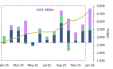
Gold Ends Lower On Mixed Data, Rate Hike Talk
Washington (Feb 5) Gold futures ended lower on Thursday, after some mixed economic data from the US with initial claims for unemployment benefits rising less than expected and trade deficit rising more than anticipated in December.
Gold prices ticked lower even as the dollar weakened, and notwithstanding some talk that the US Federal Reserve should hold off hiking interest rates beyond this summer.
Although a number of Fed speakers have indicated the bank is on track to hike rates from zero in June, prominent members of the business community are beginning to warn on the effect of such a move.
Billionaire Warren Buffett said he does not expect the Federal Reserve to raise interest rates anytime in 2015 due to the strong US dollar and the global economic uncertainty.
In economic news, a Labor Department report showed first-time claims for US unemployment benefits rebounded albeit less than anticipated in the week ended January 31 , after having reported a notable decrease in the previous week.
US trade deficit unexpectedly widened in December with imports jumping and exports falling, a Commerce Department report said Thursday. This was the widest deficit since November 2012 . Meanwhile, labor productivity in the US showed an unexpected decrease in the fourth quarter of 2014, a report from the Labor Department revealed Thursday.
Gold for April delivery, the most actively traded contract, shed USD1.80 or 0.1% to settle at USD1,262.70 an ounce on the Comex division of the New York Mercantile Exchange on Thursday.
Gold for April delivery scaled an intraday high of USD1,274.60 and a low of USD1,256.10 an ounce.
On Wednesday, gold ended at USD1,264.50 an ounce, up USD4.20 or 0.3%, aafter some disappointing economic data from the US with private sector employment growing less than expected and as China's central bank cut its reserve-requirement ratio for banks in an attempt to spur economic growth.
Holdings of SPDR Gold Trust , the world's largest gold-backed exchange-traded fund, moved up to 767.93 tons on Thursday from its previous close of 764.94 tons on Wednesday.
The dollar index, which tracks the US unit against six major currencies, traded at 93.53 on Thursday, down from its previous close of 94.57 late Wednesday in North American trade. The dollar scaled a high of 94.55 intraday and a low of 93.52.
The euro trended higher against the dollar at USD1.1486 on Thursday, as compared to its previous close of USD1.1344 late Wednesday in North American trade. The euro scaled a high of USD1.1499 intraday and a low of USD1.1305 .
On the economic front, a report from the Labor Department showed first-time claims for US unemployment benefits rebounded less than anticipated in the week ended January 31 , after having reported a notable decrease in claims in the previous week. Initial jobless claims rose to 278,000, an increase of 11,000 from the previous week's revised level of 267,000. Economists expected jobless claims to climb to 290,000 from the 265,000 originally reported for the previous week.
Labor productivity in the US showed an unexpected decrease in the fourth quarter of 2014, a report from the Labor Department revealed Thursday. Productivity tumbled by 1.8% in the fourth quarter following an upwardly revised 3.7% jump in the third quarter. Economists expected productivity to edge up by 0.2% compared to the 2.3% increase reported in the previous quarter.
Meanwhile, the Labor Department said unit labor costs surged up by 2.7% in the fourth quarter after falling by a revised 2.3% in the third quarter. Labor costs had been expected to climb by 1.2% compared to the 1.0% drop that had been reported in the previous quarter.
With imports jumping and exports falling, a Commerce Department report on Thursday showed US trade deficit to have unexpectedly widened in December. The trade deficit widened to USD46.6 billion in December from a revised USD39.8 billion in November, reflecting the widest deficit since November of 2012. Economists expected the deficit to narrow to USD37.9 billion from the USD39.0 billion originally reported for the previous month.
German factory orders rebounded at the fastest pace in five months, underpinned by both domestic and foreign demand in December. Factory orders grew a seasonally and working-day adjusted 4.2% month-on-month in December, reversing a revised 2.4% fall in November, data from Destatis showed Thursday. The latest order growth was the strongest since July, when demand rose 4.8%. The growth also exceeded a 1.5% rise expected by economists.
Germany's construction sector contracted in January, though at a fractional rate , results of a survey from Markit Economics showed Thursday. The purchasing managers' index for the construction sector dropped to 49.5 in January from 50.5 in the previous month, indicating a marginal contraction.
U.K house prices increased for the third straight month in January, survey data from Lloyds Banking Group's Halifax division showed Thursday. House prices climbed 2.0% month-on-month in January, faster than the 1.1% rise in the previous month. Economists expected house prices to remain flat during the month
Source:Alliance News