Gold: $5,400/Oz on the Horizon?
LONDON (January 27) Gold soars amid monetary shift and silver remains a steal.
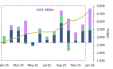
1. Goldman Is Raising Gold Price Target to $5,400
Goldman:
"We raise our December 2026 gold price forecast to $5,400 per ounce (vs. $4,900 prior) because the key upside risk we have flagged—private sector diversification into gold—has started to realise. We assume private sector diversification buyers, whose purchases hedge global policy risks and have driven the upside surprise to our price forecast, don’t liquidate their gold holdings in 2026, effectively lifting the starting point of our price forecast."

Source: TME, Goldman Sachs
2. Gold Is Making New Highs as a Monetary Realignment Unfolds in Real Time
A single chart tells the whole story: China’s holdings of US Treasuries have fallen to their lowest level in 18 years, while its gold reserves have climbed to record highs.
3. Gold Prices Needed to Back the Entire Monetary Base With Gold
Russia and Kazakhstan could implement it immediately. By contrast, the Eurozone would need gold prices to reach about $17,000, Switzerland $19,000, the United States $20,000, and Japan roughly $142,000.
Source: Lukas Ekwueme @ekwufinance
4. Silver Is Actually Cheap Relative to the Global Currency Fiat Money Supply
At $90 an ounce, silver is already at a nominal all-time high. However, when compared to the growth of the money supply (M2), it remains far below its historical peak. This gap points to meaningful upside if prices eventually reflect full monetary expansion.
- If silver returns to its 2011 ratio relative to the money supply, the price would be around $97 per ounce—nearly there already.
- If it revisits the ratio seen in the 1980s, silver could reach roughly $531 per ounce.

Source: Kasuha Research on X
5. Uranium Miners on Fire
President Trump said the US is making a strong push into nuclear energy, pointing to major improvements in safety. He emphasised that nuclear power has become both dependable and cost-effective as a source of energy for the economy.
As a result, uranium miners and the broader nuclear sector, including reactor operators, small modular reactor (SMR) developers, and utility companies, are well positioned to benefit. The Global X Uranium ETF (NYSE:URA) reflects this momentum, rising more than 20% year to date, nearly 90% over the past year, and about 270% over the last five years.
Source: Google
6. The "Arctic Trade War"
For decades, global commerce has depended on a few critical maritime chokepoints: the Suez Canal, the Panama Canal, and the Strait of Malacca. Today, the United States holds strong naval and geopolitical influence over these routes, giving it effective control over much of the world’s trade flow.
The Strategic Challenge
China’s main shipping route to Europe runs through the Suez Canal and takes roughly 40 to 50 days. More importantly, China has no real leverage along this corridor. While the Belt and Road Initiative was meant to provide a land-based alternative, those routes have fallen short. They are less efficient than sea transport, politically unstable due to crossing many national borders, and far too expensive for large-scale trade.
The Polar Silk Road Alternative
As Arctic ice continues to retreat, China is rapidly shifting its focus toward the Polar Silk Road. This move is driven by strategy, not climate considerations.
The benefits are significant:
- Faster routes: Asia–Europe shipping times could be cut by up to 40%.
- Lower costs: reduced fuel use and labour expenses per voyage.
- Greater independence: avoids US-monitored chokepoints, easing the long-standing “Malacca Dilemma.”

Source: Jack Prandelli
7. The US Is Becoming Even More Popular as a Destination for Foreign Investments
According to PwC’s CEO survey, the United States has grown more attractive to global CEOs as a destination for foreign investment, even with Trump’s policy interventions.
Source: PwC