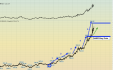
Gold ‘became money again’ under Basel III, charts point to $10,000
NEW YORK (December 8) Gold has fundamentally shifted from a speculative trade to a tier-one monetary asset following the global implementation of Basel III ‘Endgame’ banking rules earlier this year, setting the stage for a long-term move to $10,000 an ounce, according to Edward Dowd.
Dowd, a founding partner of Phinance Technologies and former BlackRock portfolio manager, told Kitco News that the yellow metal is now repricing the end of the "global sovereign debt bubble."
"Gold became money again recently when the Basel III went through... they made gold tier-one capital again," Dowd said.
Dowd is referring to the regulatory shift fully implemented on July 1, 2025, which reclassified allocated physical gold as a Tier 1 High-Quality Liquid Asset (HQLA). This change allows banks to count gold at 100% of its market value for liquidity purposes with a 0% risk weight, effectively placing it on equal footing with cash and sovereign bonds.
"We all know that we're coming to the end of a grand cycle... There's gonna be a new monetary system at some point," Dowd added.
The Bank for International Settlements (BIS) issued a warning today noting that gold and equities have entered "explosive territory" simultaneously for the first time in 50 years, with gold surging 20 percent since September. While Dowd sees a "fiat money crisis coming" that necessitates owning gold, he also issued a bold long-term price target based on technical analysis.
"The chart looks like long term it wants to go to $10,000," Dowd stated.
China’s "Voracious" Bid and The Trade Surplus Shock
Dowd noted that the structural bid for gold is being driven by central banks preparing for a monetary reset, specifically highlighting China’s aggressive accumulation.
Data released today by China’s customs agency supports Dowd’s view of a shifting global order. China reported a record trade surplus exceeding $1 trillion year-to-date, driven by a surge in exports to the Global South. Notably, Chinese exports to the U.S. fell 29 percent in November, highlighting the "decoupling" Dowd warns of.
"China has a voracious appetite for gold," Dowd said, explaining that the country is facing a demographic wall and internal economic implosion. "The leaders and the smart people in that country that have all the wealth know this."
However, Dowd warned investors not to chase prices during speculative "blow-off" tops. He cautioned that if a liquidity crisis or "Lehman type moment" hits global markets in 2026, gold could initially be sold off alongside equities.
"If gold were to go down 20, 30, 40 percent, I'd be buying it hand over fist," Dowd said. "I think gold is something you just want to continually stack when it pulls back."
"Fake" Economy and Housing Crash
Dowd’s bullishness on precious metals is underpinned by his bearish view on the U.S. economy. He argues that the resilience of the U.S. GDP over the last two years was a "hallucination" driven by government deficit spending and mass migration - a dynamic he says has now ended.
"The U.S. government basically... brought in 20 million illegal aliens and gave them money to keep this extended," Dowd said. "That floor has been removed and the housing market is rolling over."
With border crossings halted and the "illegal alien stimulus" removed, Dowd predicts a "tumultuous" 2026 for the housing sector. U.S. Census Bureau data confirms a slowdown, with housing permits peaking in early 2022 and trending downward throughout 2024 and 2025. Meanwhile, consumer stress is visible, with credit card delinquency rates recently hitting levels not seen since 2011.
"The only way that's really going to settle out is through price," he said. "Home prices are coming down and they need to come down, quite frankly."
AI "Hallucination" & The Cisco Parrallel
Dowd also warned metal investors looking for growth in the tech sector to be wary of the Artificial Intelligence boom, which he described as a "bull trap" similar to the Dot-com bubble. He specifically predicted massive downside for market leaders like Nvidia, drawing a direct parallel to Cisco Systems' collapse in 2000.
"It’s at the end of its cycle," Dowd said. "They'll go down, you know, 80 percent."
Historical data validates the comparison: Cisco Systems, once the world's most valuable company, lost 80% of its value following the March 2000 peak and took nearly 20 years to recover its nominal high. Dowd warns Nvidia shareholders face a similar "dead money" period.
"If you're buying Nvidia now at these price levels, it's gonna take, in my humble opinion, you might earn your money back in 10, 15 years," Dowd said.
Preserving Capital
With global private credit markets now exceeding $2 trillion - larger than the entire U.S. high-yield bond market—Dowd identified the sector as a potential "powder keg" for the financial system due to its opaque valuations and lack of liquidity.
"It's a Jenga tower," Dowd said. "Once you start removing some of the pieces, it has feedback loops."
For investors trying to navigate the coming volatility, Dowd’s advice is simple: preservation of capital.
"We think 2026, unfortunately, is going to be a very tumultuous year in the financial markets," Dowd said. "Cash is an asset... I would raise some cash to take advantage of lower prices."
KitcoNews