
Why Is Gold Surging? How High Can Gold Go and Gold Price Prediction 2026
LONDON (March 25) Monday's intraday move to $4,100 was alarming. But what happened next was more important than the drop itself. Before Monday's session closed, gold recovered decisively, leaving a pin bar with a very long lower wick and a narrow body on the daily chart. That candle rejected two critical supports simultaneously: the 200-day MA at approximately $4,200 and the October 2025 historical highs at $4,306. Both held.
Tuesday's session produced a second pin bar - shorter lower wick, same rejection message - confirming that Monday's reversal was not a one-session anomaly. Wednesday is the follow-through: a 1.9% rally to $4,555 that is now pushing gold back into the resistance zone that Konrad Ryczko, analyst at BossaFX, identifies as structurally important.
Ryczko frames the current situation precisely: "For an outside observer it might seem that the prospect of reduced geopolitical tensions should result in outflows from safe-haven assets. Yet gold remains in recovery mode after the crash from around $5,000 to $4,100. The metal is gaining on a technical basis and slightly weaker USD.
Additionally, the market is living by the thesis that 'people buy gold when they fear for the future, and sell when they fear for the present.'" He identifies the current resistance zone at $4,578-$4,686 as the key area gold needs to clear to extend the recovery - exactly the zone being tested on Wednesday.
The Trump-Iran diplomatic signal was the catalyst. As reports emerged that the US had postponed further military action on Iranian power plants and described "effective talks," oil reversed, the dollar softened slightly, and the safe-haven bid rotated back into precious metals. That macro backdrop gave the technically oversold gold chart the permission it needed to bounce.
XAU/USD Technical Analysis: A Buy Signal With a Long Journey Ahead
As my chart shows, the double pin bar rejection of the 200 EMA and the $4,306 October highs is one of the clearest technical buy signals I have seen on the gold chart this year. In the previous gold analysis from Monday, I identified these exact levels as the final structural defence of the bull trend. The market tested them and rejected them decisively. That is the textbook definition of a support confirmation.
Setting fundamentals and geopolitics aside - which is admittedly very difficult in the current environment - the technical picture now points toward a potential recovery toward the all-time high zone at $5,600 set on January 29. The path is not clear of obstacles.
The first resistance is the 50-day EMA at approximately $4,800, where a cluster of sellers who averaged into the decline will likely defend. Above that, the $5,000 psychological level represents both a round number and a zone of prior support that has now flipped to resistance. But above $5,000, the road back to $5,600 stands technically open.
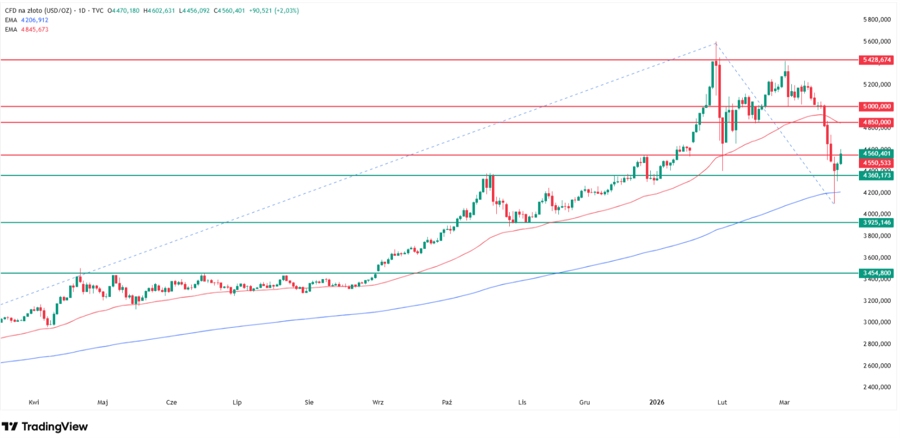
The more speculative but mathematically grounded analysis comes from the Fibonacci extension. Measuring the entire 2025 uptrend from its base and then the 2026 corrective decline, the 100% Fibonacci extension falls at just over $7,000 per ounce - representing approximately 54% upside from Wednesday's $4,555.
The 161.8% extension lands just below $9,000 - approximately 97% upside from current levels. I present these as analytical curiosities from the chart rather than primary price targets, but they reflect the mathematical potential of the trend structure if the bull market resumes in full.
Level | Type | Notes |
$9,000 | Fibonacci 161.8% extension | ~97% upside from current |
$7,000 | Fibonacci 100% extension | ~54% upside from current |
$5,600 | All-time high (Jan 29, 2026) | ATH retest - ultimate bull target |
$5,000 | Psychological resistance | Former support, now resistance |
$4,800 | 50-day EMA | First major resistance on recovery |
$4,578-$4,686 | Key resistance zone (Ryczko) | Must clear to extend rally |
$4,555 | Current price (Mar 25) | +1.9% Wednesday |
$4,306 | October 2025 highs | Held as support Monday |
$4,200 | 200-day EMA | Bull/bear dividing line, held |
$4,100 | Monday intraday low | Pin bar reversal point |
Why the 200 EMA Held: The Structural Case Has Not Changed
The structural supports that drove gold from $2,600 to $5,600 remain intact, and they are precisely why buyers stepped in at $4,100-$4,200 rather than letting the selling continue. As goldsilver.com noted in their March analysis: "The structural reasons gold ran from $2,600 to over $5,000 in twelve months haven't changed. Central banks are still buying. The dollar outlook is still soft. US fiscal deficits aren't shrinking".
JPMorgan's analyst Gregory Shearer made the institutional case for holding through the correction with unusual directness: despite the recent volatility, the bank "advises investors to stay the course with gold" and has maintained its $6,300 year-end 2026 target - representing a 38% rally from Wednesday's $4,555. Bargain buying and short-covering at the 200 EMA is exactly the rational institutional response to a 23% correction in an asset with intact structural fundamentals.
The Iran de-escalation also changed one of the key negative inputs for gold. Rising oil had been feeding inflation expectations that kept the Fed hawkish and yields elevated - the primary mechanism through which the Middle East conflict was actually hurting gold by the monetary channel.
A pause in the conflict reduces oil, reduces inflation pressure, reduces rate expectations, weakens the dollar, and simultaneously adds back gold's safe-haven premium. All four inputs move in gold's favour simultaneously - which explains the speed and conviction of Wednesday's recovery.
The 2026 Gold Price Predictions: Every Major Institution
The comprehensive gold price prediction analysis from February 17 established the full institutional forecast landscape, and the March crash has not fundamentally changed any of the major banks' year-end targets - if anything, the 23% correction has made those targets easier to maintain without appearing detached from reality.
JPMorgan's $6,300 forecast - published February 3 and reaffirmed through the crash - is built on approximately 800 tonnes of projected central bank gold purchases in 2026 and private-sector diversification away from dollar-denominated assets. Wells Fargo's $6,100-$6,300 range from February 8 sits in the same zone. Both forecasts imply a 35-38% rally from Wednesday's price - achievable if the pin bar reversal has genuinely marked the bottom of the correction.Goldman Sachs raised its year-end target to $5,400 in January and has maintained it since, citing central bank buying momentum and private diversification. ANZ Bank's $5,800 target from February 16 represents the mid-range institutional bull case, while BNP Paribas raised its 2026 average forecast to $5,620 with a peak above $6,250 flagged as possible. At the extreme bull end, Saxo Bank's $10,000 scenario - published February 11 - sits in the same territory as my 161.8% Fibonacci extension just below $9,000.
The notable contrarians are HSBC at $4,450 and Standard Chartered at $4,488 - both published before the crash, which means the market has already traded through their year-end targets at the recent lows. The Reuters poll median of $4,746 across 30 analysts is the most genuinely consensus-based figure and sits approximately 4% above Wednesday's price.
Finance Magnates