Gold Miners’ Greatest Quarter


The gold miners’ recently-finished Q4’25 will soon prove their greatest quarter ever fundamentally! Their coming reported earnings are going to skyrocket to epic records, mostly due to astonishing record gold prices. But stable mining costs and production will also contribute to phenomenal results. Such crazy-strong fundamentals will drive down gold-stock valuations, making them great buys on any material gold weakness.
With Q4’25 in the books, another quarterly earnings season draws near. Analyzing gold miners’ latest operational and financial results illuminates their current underlying fundamentals. Digesting them is very important for speculators and investors, temporarily dispelling the shrouds of herd sentiment usually obscuring this high-flying sector. How gold miners are actually faring reveals whether they remain worthy of buying.
Following most quarters, American-listed gold miners have 40 calendar days to report their financials to securities regulators. In Canada which is the epicenter of the gold-stock universe, quarterly deadlines run 45 days. But Q4s are different in both countries, having extended reporting windows running 60 days in the US and a whopping 90 days in Canada! So Q4 results mostly get released from mid-February to mid-March.
While it’s frustrating having to wait so long for Q4 results, those delays are understandable. Most companies run their fiscal years on calendar ones, with Q4 year-ends. So unlike normal quarterlies, their Q4 results are long comprehensive annual reports that have to first be audited by accounting firms. Preparing those and getting accountants to bless them takes much more time than lesser-scoped unaudited quarterlies.
After a quarter-century-plus intensely studying and actively trading gold stocks, earnings season feels like Christmas to me. Analyzing those valuable quarterly fundamental reads shows whether this sector is overvalued or undervalued, and where valuations are trending. Couple that knowledge with buying and selling decisions based on gold’s technicals, overboughtness and oversoldness, yields fantastic trading results.
Fully 26 years ago this week, I founded my financial-research company Zeal. We sell popular weekly and monthly newsletters detailing our ongoing research and resulting trades, mostly gold stocks. During that entire span, we’ve recommended and closed 1,621 newsletter stock trades. All including losers have averaged fantastic annualized realized gains of +20.4%, more than double the long-term stock-market average!
Achieving this stellar track record most hedge funds would die for required a holistic approach integrating technicals, fundamentals, and sentiment. In the first half of that quarter-century, we did the fundamental analysis behind the scenes. Then about a decade ago, I figured why not write about it and share it? So for 38 quarters in a row now, I’ve publicly analyzed the leading gold miners’ latest quarterly results in essays.
After every quarter I dig into the quarterlies from the top-25 components of both leading gold-stock ETFs, GDX and GDXJ. The former is dominated by large major gold miners, the latter by smaller mid-tier and junior ones. The resulting spreadsheets have grown huge, offering increasingly-valuable insights on gold-miner fundamental trends. These become clearer as more individual-miner quarterly data is accumulated.
Without any doubt, gold miners’ upcoming Q4 results will prove their best-ever by far utterly smashing all previous records! They are going to leave fund managers not paying enough attention awestruck. The dominant reason is last quarter’s soaring and epic record gold prices. Gold miners’ earnings naturally amplify their metal’s fortunes, as their overall mining costs change far more slowly than volatile gold prices.
Astoundingly gold averaged a stupendous $4,150 in Q4, skyrocketing a jaw-dropping 56.0% year-over-year! Both crushed their previous records of $3,459 in Q3’25 and a 40.6%-YoY surge in Q2’25. Last quarter was off-the-charts-huge, a marked acceleration. During the last ten quarters ending Q4’25, average gold prices soared 11.6%, 14.2%, 9.5%, 18.2%, 28.6%, 34.7%, 38.3%, 40.6%, 39.7%, and that 56.0% YoY!
That all-important gold-price component of gold miners’ earnings is trivial to calculate right after quarter-ends. But the mining-cost side is way more challenging, requiring extensive back-data and experience. The best industry-wide mining-cost measure is all-in sustaining costs per ounce. AISCs not only include all cash expenses incurred operating gold mines, but additional capital necessary to sustain their outputs.
For most gold mines, AISCs do gradually climb over time due to monetary inflation forcing up general-price levels. But for the most part, they are largely fixed during pre-construction planning stages. That’s when engineers determine which gold deposits to mine, how to excavate them, and how to process their ores. Once constructed, processing plants’ designed nameplate throughputs don’t change quarter-to-quarter.
Thus outside of rare expansions, any gold mine’s operations generally require similar levels of infrastructure, equipment, and employees to keep running quarter after quarter. So compared to volatile gold prices, mining costs are almost static. The GDX-top-25 majors’ average AISCs in the last nine reported quarters starting in Q3’23 have run $1,325, $1,296, $1,297, $1,289, $1,431, $1,454, $1,396, $1,424, and $1,544.
Their average year-over-year increase during this span ran 4.0%, far behind gold’s 26.1% average! And if you throw in Q4’25’s epic gold performance, its last-ten-quarter average gains grow to 29.1%. Gold-price growth far outpacing average mining costs yields much-higher unit earnings, which in turn translate into exploding bottom-line profits for gold miners. That has sure been apparent in the GDX top 25 recently.
Subtracting their quarterly-average AISCs from the quarterly-average gold prices offers the best views of sector profitability and trends. This metric is much cleaner than accounting earnings, which are often distorted by unusual non-cash items flushed through income statements. That revelation came from a quarter-century of deep-gold-stock-analysis experience layered on top of a uniquely-suited background.
I studied both finance and accounting at university, went to work for a leading global accounting firm right out of college, obtained my CPA license, and audited mining companies for a living. I’ve maintained active CPA status ever since, and delving into quarterlies remains one of my favorite parts of my work. It’s fascinating following the evolution of individual gold miners and mines, which rewards with superior trade selection.
In these last nine reported quarters, the GDX top 25’s implied unit profits clocked in at $601, $680, $775, $1,048, $1,046, $1,207, $1,470, $1,861, and $1,915 per ounce. The last six were all records, besting the previous one of $884 from Q3’20. That outstanding unit-earnings growth is even more apparent in year-over-year terms, soaring an epic 87.2%, 46.7%, 31.5%, 75.3%, 74.0%, 77.5%, 89.7%, 77.6%, and 83.1%!
Averaging a jaw-dropping +71.4% YoY in this span, that has to be unrivaled in all the stock markets! And Q4’25’s unit profits are going to accelerate this extraordinary streak. The GDX top 25’s historical data can feed into an AISC estimate for last quarter before we get the actual results later. A year ago in Q4’24, the GDX top 25’s AISCs averaged $1,454 per ounce. Coincidentally that’s also exactly their last-four-quarter average.
In this nearly-decade-old research thread, GDX-top-25 AISCs in Q4s averaged 0.9% quarter-on-quarter increases from preceding Q3s. Applying that to Q3’25’s record-high $1,544 AISCs yields a potential target of $1,558. So the rough range of probable Q4’25 AISCs runs from $1,450 to $1,550. Fleshing that out a bit more, in their Q3’25 results the GDX top 25’s average all-in-sustaining-cost guidance for full-year 2025 ran $1,528.
My best guess is these elite major gold miners’ AISCs will average near $1,525 last quarter, which would be up 4.9% YoY. Fluctuations in this GDX-top-25 average are sometimes affected by changes in which gold miners make the bottom end of that group. Lower-cost ones can edge out higher-cost ones or vice-versa. Favorable composition changes in the GDX top 25’s lower ranks could substantially lower Q4’s average.
But to be conservative, let’s assume last quarter’s average AISCs surged again to a record $1,600 per ounce. That’s getting up near worst-case-scenario territory, quite unlikely. Yet subtract $1,600 from Q4’25’s astounding record $4,150 average gold price, and that implies mind-blowing GDX-top-25 implied unit earnings of $2,550 per ounce! That would skyrocket a staggering 111% YoY, more than doubling Q4’24!
Anything in this ballpark would utterly shatter Q3’25’s previous record of $1,915. The gold miners just achieved their greatest quarter ever by far, which will become apparent when Q4’25 results are released from mid-February to mid-March! The resulting also-massive-new-record bottom-line earnings will blast gold-stock valuations sharply lower, even with gold stocks at record highs. Fund managers will be amazed.
In addition to those unusual non-cash items distorting operating income, another consideration plays into bottom-line profits feeding trailing-twelve-month price-to-earnings ratios. That is gold miners’ production levels. Producing more gold to multiply these record unit profits across will naturally boost bottom lines. And two different methodologies of estimating Q4’25 output project it will either remain stable or strengthen.
The first is narrower, encompassing this GDX-top-25 dataset over these last 38 quarters. On average in that span, quarter-on-quarter output plunged 8.9% in Q1s, was flat at 0.0% in Q2s, grew 2.4% in Q3s, then surged 6.1% in Q4s! Fourth-quarter production growth proved the strongest for these elite majors over the last decade or so. But GDX-top-25 composition changes over the years have skewed this some.
One example is GDX’s managers long included a huge Chinese mining conglomerate. While it produces major gold, that represents just a small fraction of its overall revenues. Far from a primary gold miner, it never should’ve been included in GDX. There have also been occasional big acquisitions, one major gold miner buying out another. And the lower ranks of the GDX top 25 shifting also affects these comparisons.
The World Gold Council offers a much-more-comprehensive window into global gold-mining output. The WGC’s outstanding must-read quarterly Gold Demand Trends reports include extensive historical data of overall world gold-mining production stretching back to 2010. On average since, that plunged 9.1% quarter-on-quarter in Q1s, climbed 5.1% in Q2s, surged a hefty 6.8% in Q3s, and remained stable in Q4s up 0.3%.
So odds are major gold miners’ Q4’25 production will at least stay up near Q3’25 levels, contributing to epic record bottom-line profits. Incidentally that big quarterly output drop from Q4s to Q1s is largely due to winters in the northern hemisphere, which includes over 2/3rds of the world’s land masses and a proportional majority of its gold mines. Cold and/or wet weather retards gold-mining operations on multiple fronts.
Up north colder temperatures reduce the efficiencies of heap-leach chemical reactions to recover gold from ores. Down south heavy rains diluting leaching solutions also slow recoveries. And mine managers take advantage of Q1’s bad weather to schedule necessary maintenance, sometimes taking mines offline. But peak northern-hemisphere winters in Q1s are no concern for these upcoming record Q4’25 results.
This is certainly a ringing fundamental endorsement for gold stocks, as greatest quarters ever hammering valuations lower are rare and awesome! But that sure doesn’t mean now is a great time to rush to buy in and chase these record gold-stock prices. While fundamentals reveal if trades are good values likely to appreciate in the long-run, short-term trade timing is exclusively the realm of technicals and sentiment.
And holy cow gold and gold stocks remain extremely-overbought after soaring way too far too fast to be sustainable! I wrote a whole essay last week explaining why a gold reckoning looms in early 2026, either a big-and-fast drawdown or a much-slower high consolidation. The former would likely be on the order of a 20% selloff, the latter closer to 10%. GDX amplifies material gold moves because miners’ profits leverage gold.
Since GDX was born way back in mid-May 2006, it has tended to leverage gold by 2x to 3x. So with a large gold pullback challenging 10%, GDX would almost certainly drop 20% to 30%. And with a serious correction approaching 20%, those gold-stock losses would be very likely to balloon to a brutal 40% to 60%! Buying gold stocks while gold is super-high and likely to roll over is foolish, they’ll get sucked into its selling.
While analyzing today’s extreme gold-stock technicals is beyond the scope of this fundamental essay, check out this GDX chart. This dominant gold-stock benchmark has not only skyrocketed 173% in just over a year, it is stretched nearly 50% above its baseline 200-day moving average! Technically gold stocks are as extreme as they’ve ever been in GDX’s entire history, crazy-overbought and due for a major rebalancing.
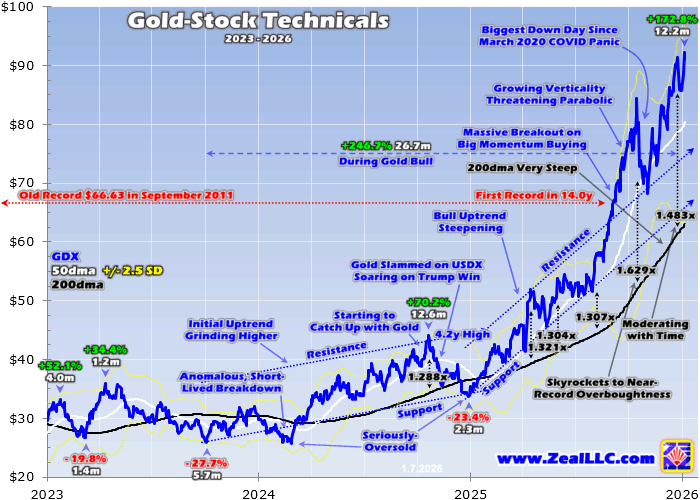
In coming weeks I’ll probably write a pure gold-stock-technicals essay illuminating all this in context. But for now, realize epic record gold-miner fundamentals won’t overpower any gold-driven drawdown. If gold rolls over materially, gold stocks will follow amplifying their metal’s losses. After that has mostly run its course is the time to buy, when gold-stock prices are considerably lower making them much-better buys.
Again gold miners won’t release their combined Q4 and full-year-2025 results until mid-February to mid-March. Before that, the great majority of traders and fund managers won’t yet be aware of how astonishing gold miners’ fundamentals are. That timeframe is interesting. Gold just soared a monster 148.8% in 26.7 months without a single 10%+ correction, making for its largest cyclical bull ever in dollar terms by far!
Immediately after its next-ten-largest cyclical bulls since 1971, gold averaged big-and-fast selloffs running 20.8% in just 2.1 months! If a similar healthy reckoning to rebalance extreme technicals and sentiment happens soon this time around, gold and its miners’ stocks could be bottoming during this upcoming Q4 earnings season. That would make for a good buying opportunity, we’d aggressively add newsletter trades.
Successful trading demands always staying informed on markets, to understand opportunities as they arise. We can help! For decades we’ve published popular weekly and monthly newsletters focused on contrarian speculation and investment. They draw on my vast experience, knowledge, wisdom, and ongoing research to explain what’s going on in the markets, why, and how to trade them with specific stocks.

Our holistic integrated contrarian approach has proven very successful, and you can reap the benefits for only $10 an issue. We extensively research gold and silver miners to find cheap fundamentally-superior mid-tiers and juniors with outsized upside potential. Sign up for free e-mail notifications when we publish new content. Even better, subscribe today to our acclaimed newsletters and start growing smarter and richer!
The bottom line is gold miners will soon report their greatest quarter ever. Their upcoming Q4 results due out from mid-February to mid-March will utterly smash all records. Last quarter’s astounding record gold prices combined with stable mining costs will fuel exploding earnings, driving down valuations. And major gold miners’ production is also likely to hold steady, contributing to incredibly-rich-and-fat bottom lines.
But phenomenal fundamentals don’t mean now is a great time to add gold-stock positions. Gold remains extremely-overbought and drenched in greed, overdue for a healthy reckoning. Major gold stocks will amplify any material gold drawdown by 2x to 3x like usual. After that largely passes rebalancing technicals and sentiment, gold stocks will enjoy a way-higher-probability-for-success time to buy. That’s when to flood in.
********