
Here are today's videos and charts. The videos are viewable on mobile phones as well as computers.
Current Price of Gold Today
Gold Prices per Ounce, Gram, and Kilogram
| Gold Price Now | Change | ||
|---|---|---|---|
| Gold Price per Ounce | $2,336.34 | +1.54 | |
| Gold Price per Gram | $75.12 | +0.05 | |
| Gold Price per Kilo | $75,113.33 | +49.51 | |
| As of Apr 26, 2024 01:25 PM ET | |||
| Gold is by +0.07% |
Show
in
The latest price of gold per ounce, gram, and kilogram using real-time interactive gold price charts. View the price of gold for different currencies around the world and various time periods. Historical gold prices are provided for context and to help inform investment decisions.
Gold Eagle has been a premier destination for gold prices since the dawn of the internet, founded in 1997. We publish gold market news, gold price forecasts, and commentary that provides insight into the current and future price of gold, precious metals, and the state of the economy in general. Our authors and analysts are some of the most respected in the world.
Gold Price Performance per
| Timeframe | Rate | Change | % |
|---|---|---|---|
| 1 Week | 2,329.93 | +6.41 | +0.28% |
| 2 Weeks | 2,156.08 | +180.26 | +8.36% |
| 30 Days | 2,195.20 | +141.14 | +6.43% |
| 6 Months | 2,006.33 | +330.01 | +16.45% |
| 1 Year | 1,988.61 | +347.73 | +17.49% |
| 5 Years | 1,285.99 | +1,050.35 | +81.68% |
| 10 Years | 1,304.21 | +1,032.13 | +79.14% |
Gold Price Charts
By hovering your mouse within the graph of the Gold prices chart you can also view the price of Gold for specific days.
Price of Gold FAQ
What impacts the current price of gold per ounce?
- Strength of US dollar
- Industrial and commercial demand
- Gold supply
- Fed actions / monetary policy
- Geo-political events
- US interest rates
- Inflation expectations
- Investment demand
For a detailed explanation, read What Affects The Price of Gold.
How does the price of gold perform during recessions?
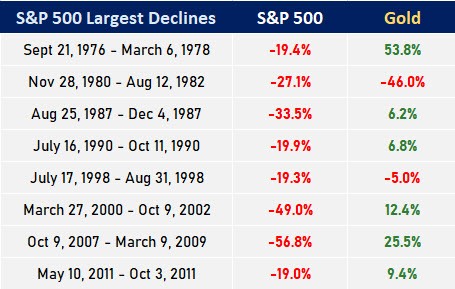
Gold prices typically increase during economic recessions. One way to analyze gold prices during a recession is by comparing its performance with the S&P 500. Below are the dates of the largest declines of the S&P 500 and the performance of gold prices during the same period. This data shows that gold increased significantly in 75% of these recessions.
Is the price of gold different in other countries?
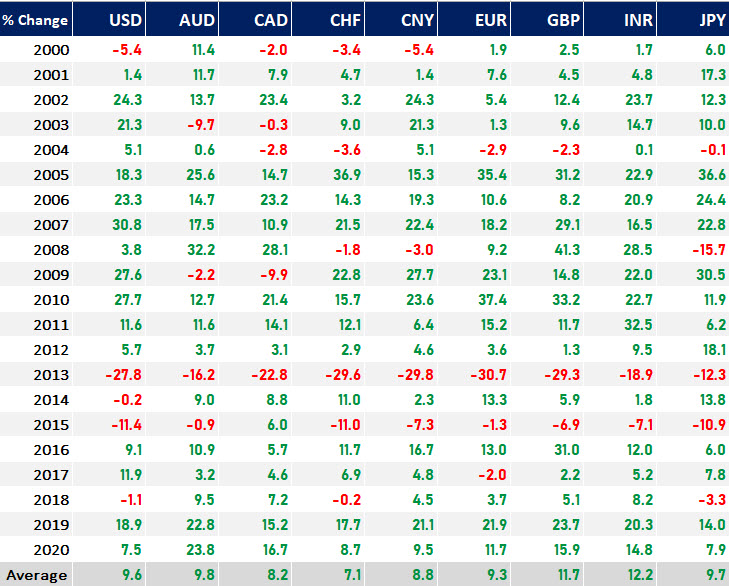
The current price of gold is the same, all things considered, in other countries. The US gold price is converted to the currency in that country based on the current exchange rate. In other words, no matter where in the world you purchase gold, the actual value of that gold in US dollars is the same. The below chart shows the annual gold price performance versus various fiat currencies.
How many grams are in an ounce of gold?
There are 31.1034807 grams in one troy ounce of gold. A troy ounce is a larger system of measurement for precious metals known as Troy weights. A regular ounce of gold is equal to 28.35 grams.
How does the current gold price compare to historical gold prices?
The price of gold has increased approximately 4,750% since 1935 when President Franklin D. Roosevelt raised the value of gold to $35 per ounce. This is compared to today’s gold prices (June 2020) that are hovering around $1,700.
If you compare the goldprice today (June 2020) with the prices at the beginning of this millennium (January 2000), the price of gold has increased approximately 496%. This is 3x the increase of the Dow Index during this period.
Is the price of gold too volatile for the average investor?
Gold is no more volatile than the stock market. Gold prices can have sudden ups and down just like other commodities but it is also known to go through long periods of time with relatively quiet price activity. Overall, gold is viewed by many financial experts as a long-term store of value which is why so many recommend having gold as part of your investment portfolio.
Is it true the price of gold goes up when the stock market goes down?
The price of gold is negatively correlated to the stock market most of the time. When the markets go down gold prices often go up. That being said, there are times when the price of gold and the stock market both go up or down in unison. Overall, however, time has shown that gold prices are not tied to the movements of stocks and bonds and it is for this reason the gold should be an important consideration to protect the long-term value of your investment portfolio.
Do current gold prices vary by country?
The price for an ounce or gram of gold remains mostly the same regardless of which country you are in. The price is determined by converting the current spot gold price for an ounce or gram of gold into the country"s currency. For example, the current spot gold price for 1 gram of gold would be converted into Indian Rupees according to the current exchange rate.
How is the current price of gold per ounce determined?
There are many factors that contribute to the current price of gold. Chief among these factors is the strength of the US dollar. Traditionally gold has an inverse relationship to the value of the dollar. In other words, when the value the US dollar is strong, gold prices go down. Related, the strength of major economies also has an inverse relationship to the price of gold - at least when an economy has a significant downturn. All of this is due to the “safe haven” status gold has traditionally had in the investment world. Gold prices are historically far more stable over the course of time than economies and other classes of investments.
Supply and demand, of course, also play a key role in the price of gold per gram or ounce. There is only so much gold to be mined and gold mining is not cheap. When gold demand outstrips gold supply, the price of gold goes up. The chief areas of gold demand are in gold jewelry. In 2017, 46% of demand for gold was for jewelry. There is also the use of gold in industry for such things as electronics and medical devices.
How much is an ounce of gold?
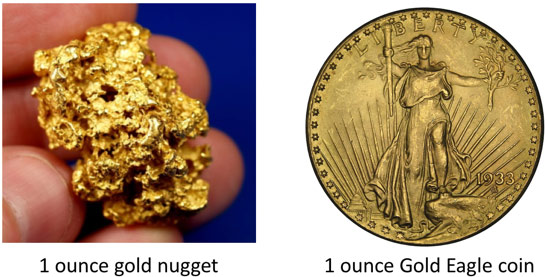
The price of gold per ounce is perhaps the most common way investors monitor the gold market. The image below shows a 1 ounce gold nugget and a 1 ounce gold coin - in this case a gold eagle coin. The Gold Price Now chart at the top of the page shows the current value of gold in US dollars. You can also get the price of gold in other world currencies by selecting a different currency from the drop down menu below the chart.
What is the gold/silver ratio?
The gold/silver ratio is the relationship between gold and silver prices. Investors often consider the historical gold/silver ratios to analyze how they are priced relative to one another.
Featured Gold Price Articles
I’m not a perma-bull on gold, and I invest in a variety of asset classes depending on where value is in the market. For example, I sold my gold and silver coin collection at high levels in 2011 because there was so much enthusiasm in the space...
We cannot value gold. It does not generate any cash flows, which we could discount. But it doesn’t mean that the price of gold changes randomly. Market sentiment is powerful in the precious metals market – but the same applies to other markets (after all, humans are emotional creatures). However, it does not operate in a void. Actually, there are some important fundamental drivers at work. Just like in the cosmos. It seems to be empty space – but gravity works there. Similarly, the precious metal market seems to be very emotional and without any logic, but when you look closely, you will discover important forces in action. What are they?
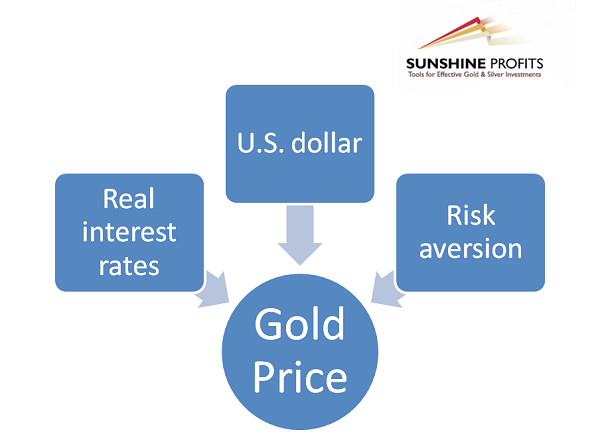
Our research has shown that the most important elements in the gold’s puzzle are: the real interest rates, the U.S. dollar, and the risk aversion (although its less seen in the data). It’s the Golden Triad of Gold’s Drivers (see the diagram below). Let’s analyze them.
Diagram 1: Golden Triad of Gold’s Drivers.
Real Interest Rates And Gold Prices
Why do the real interest rates matter for gold? Well, resources are scarce. Everything comes with a cost. Holding the yellow metal in a portfolio is not an exception here. Some costs are clear: storage and insurance of gold. But these expenses are not the main costs. The most important are the opportunity costs for foregone interests. Instead of holding gold, investors could be lending it (or the cash spent) out. The higher the real interest rates, the larger are the opportunity costs of investing in gold, so investors are less willing to hold a lot of the shiny metal (think about the 1980s and the 1990s, when Volcker increased nominal interest rates, pushing the real rates higher). And the lower real interest rates, the smaller are the opportunity costs, so people are more eager to hold more gold. In particular, the negative real interest rates are gold’s real friends (the 1970s or the post-Lehman era are the best examples).
The key is that if on aggregate people want to increase their gold allocation, the only way for that is when the price of gold rises relative to other investment assets. This is because if all people desire more gold, there is nobody there to buy from, so its relative price has to increase to force some bullion holders to sell it. Gold is money, so when all try to hold more of it, its price has to rise.
And what do the data say? As one can see in the chart below, the long-term correlation (since 2003) between the real interest rates and the gold prices is -0.87.
Chart 1: The price of gold (yellow line, left axis, P.M. London Fix) and the U.S. real interest rates (red line, right axis, yields on 10-year Treasury Inflation-Indexed Security) from 2003 to 2018 (weekly averages).