
Latest Gold Price Forecast & Predictions
Gold Price Now:
USD
$4,493.79
0.00
0.00%
Recent Changes
| Period | 2 Days | 3 Days | 1 Week | 2 Weeks | 1 Month |
|---|---|---|---|---|---|
| Change | +1.26% | -0.38% | -0.01% | -10.48% | -13.26% |
Gold Price Forecasts - Analyst Predictions
Gold-Eagle has been analyzing gold markets and publishing gold price forecasts for over 23 years. Our staff and contributing analysts include world reknowned precious metal experts and market analysts. The gold price forecast data below represents the average predictions of a diverse panel of expert gold market analysts. Their assessments of gold price trends are based on a variety of methods including: expert technical analysis, market fundamentals, current market sentiment, and an analysis of global economic and political events. Bookmark and/or link to this page to check back every week. Updated every Monday am.
Last Updated: March 18, 2026
Gold Forecast Short Term
Bearish
Price Drivers for next 6 weeks:
us dollar, Iran conflict, geopolitical uncertainty, inflation reportGold Forecast 1 Year
Bullish: $5,650
Medium-term price drivers:
weaker US dollar, economic uncertainty, inflation, geopolitical uncertainty, fiscal concernsGold Forecast 3 Years
Bullish: $7,275
Long-term price drivers:
US dollar, Central Bank buying, de-dollarization, geopolitical uncertainty, fiscal concerns/debtFeatured Gold Price Forecasts
 Gold has pulled back to its 200-day moving average for the first time in over two years. While precious metals are attempting to find a floor, broader market stress continues to weigh on the sector.
As long as the Strait of Hormuz remains closed, the risk of a global recession increases by the day—and the Fed may be unable to respond until after markets have already taken significant damage.
Soaring bond yields signal tightening liquidity and ongoing inflation concerns. With private credit already under pressure, the situation could deteriorate further, raising the risk of a significant market selloff in April.
10-Year Yields
After peaking slightly above 5.00% in 2023, the 10-year Treasury yield has largely been consolidating within a narrowing range. The conflict in Iran has pushed yields higher, reflecting inflation and growing liquidity concerns. A decisive breakout above the upper boundary near 4.60% would signal increasing stress, while a move to new highs could have severe consequences for financial markets.
 With the action seen over the past week or so, the downward phase of the 34-day cycle was confirmed to be back in force - with the same now seen as true for the bigger 72-day component. With that, the next decent swing low should come from the combination of these waves, ideally set to play out into early-to-mid April.
Gold's 10-Day Cycle
For the very near-term, the downward phase of our smallest-tracked cycle - the 10-day wave - is also viewed as in force, and with that is into normal bottoming range. Here is that nominal 10-day component in Gold:
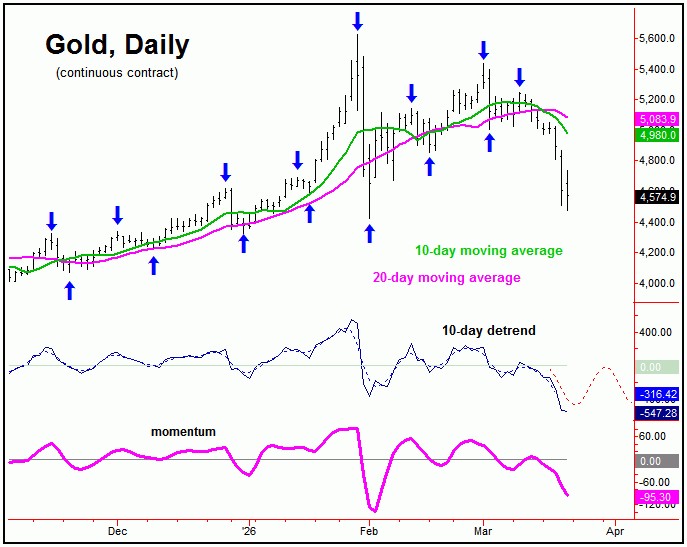
In terms of time, the current correction phase of this 10-day wave is now some 13 trading days along - which puts it in the back-end of normal bottoming range. With that, the next short-term rally should come from this cycle - which is due to materialize at anytime.
Having said that, it would currently...
Another big bank has raised its gold forecast.
This time, it’s JPMorgan expressing more bullish sentiment despite the recent correction.
The big bank raised its 2026 gold forecast from $5,055 per ounce to $6,300.
JPMorgan analysts note that the 11 percent correction late last month ranks alongside some of the largest down days in gold's history, including January 1980's 13 percent fall and the 12 percent slump in February 1983.
However, they emphasize gold bugs shouldn’t be worried.
"Even with the recent near-term volatility, we remain firmly bullishly convinced in gold over the medium-term on the back of a clean, structural, continued diversification trend that has further to run amid a still well-entrenched regime of real asset outperformance vs. paper assets."
JPMorgan analysts also lay out a case for $8,000 gold if households meaningfully increase their allocations. This underscores that while gold may become oversold at times, it is still significantly underinvested.
There has been growing interest in gold as a portfolio diversifier. Last fall, Morgan Stanley CIO Michael Wilson said investors should consider abandoning the traditional 60/40 equity/bond portfolio allocation and adopt a 60/20/20 distribution with 20 percent allocated to precious metals.
...
More Gold Price Forecasts

The Fed struck a moderately hawkish tone, emphasizing uncertainty, which is likely to limit the odds of rate cuts in 2026. The recent breakdown in precious metals and mining stocks feels like the final washout heading into an intermediate low.

The conflict involving Iran is moving further up the escalation ladder, and White House advisor Robert Pape warns that we may be caught in an escalation trap. According to Pape, the next phase (stage 3) could involve U.S. boots on the ground in Iran, a development that...

Gold price forecast 2026: New all-time highs ahead — then a 25% drop. Cycle analysis reveals the key turning points to watch.
The conflict with Iran is intensifying, and the shutdown of the Strait of Hormuz is a major wildcard that could spark a global market shock.

The primary uptrends in gold, silver, and the mining shares remain firmly in place, reinforcing the case for fresh highs into the second quarter. A speculative blow-off phase—carrying gold above $8,000 and silver beyond $200—cannot be ruled out.
In October, Bank of America raised its 2026 gold price forecast to $5,000. Mission accomplished as of January 23. Now the big bank has upped its projection again, calling for $6,000 gold this year.

From the comments made in past months, Gold's larger rally phase was projected to hold up into February of this year, which favored each of the in-between corrections to end up as countertrend. With that, we are moving into the range where a key peak is expected to...

As mentioned in my last article back in late-December, Gold was setting up for a key short- term correction, coming from several smaller tracked waves - though a move anticipated to end up as countertrend, before turning higher again into February. This February, 2026...

Gold investors: the fourth turning is upon us. Yes, that is right – a signal so rare, so powerful, and so ominous that it has appeared only three times in the last 130 years – has now shown itself.
Gold Price Forecast FAQ
How do you forecast the price of gold?
Predicting gold prices can be said to be both a science and an art. For example, analysis of gold supply and demand is scientific and completely objective whereas aspects of technical and sentiment analysis of the current gold market can be more of an art as it relies on the skills and perspective of the gold analyst.
Generally speaking, when the focus of the gold forecast is longer term then analysis of the fundamentals, ie scientific analysis, comes to the fore.
For shorter-term predictions of gold prices, the price of gold in the coming weeks and perhaps few months, technical analysis of past and current gold prices, market trends, as well as current market sentiment can be more actionable predictors. Here, the fundamentals can still play a role but generally serve more as background details.
What are the key factors for long term gold forecasts?
When forecasting what may happen to the price of gold longer term, there are many things to consider including economic trends, the impact of current and expected monetary policy, QE, debt monetization, and the aggregate impact on future currency valuation.
Does the price of gold go up when the stock market goes down?
The price of gold is often negatively correlated to the stock markets. When the markets go down, gold prices usually go up. However, this is not always true. Sometimes the price of gold and stocks both go up and down in unison. Fundamental factors play an important role and need to be carefully analyzed. Historically, however, the price of gold is not tied to the fluctuations of stock and bonds. This is one of the chief reasons when one should have gold in their portfolio – to protect the long-term value of your investments.
Does the value of the US dollar predict the price of gold?
As gold is traditionally quoted in US dollars, the price of gold is negatively correlated to the strength of the USD. The weaker the US dollar, the cheaper it is to purchase gold. Therefore, if economic factors predict a strengthening of the US dollar then this will tend to drop the price of gold, and vice-versa. According to the statistics (since 1973), the long-term correlation between the U.S. dollar index and the gold prices is -0.6 so this link is quite strong.
How do US interest rates impact future gold prices?
The level of US interest rates is an important driver of future gold prices. When investing in gold, the investor is faced with the opportunity cost of gold - a non-interest bearing asset. The higher the US interest rate for holding US dollars or investing in Treasuries, the higher the opportunity cost of holding gold. It is more likely, therefore, that a rally in the price of gold will be forecasted the lower the US benchmark interest rate.
Gold Forecast Analysts

Technical Analysis Expert & Editor @ GoldPredict.com
AG Thorson is a registered CMT through the MTA and an recognized expert in technical analysis of the precious metals markets. He is also the Editor of GoldPredict.com where members receive daily updates and regularly scheduled reports 3-days a w More...

Chief Analyst & Founder @ iGold Advisor
Christopher Aaron began his career as an intelligence analyst for the CIA and Department of Defense. He served two tours to Afghanistan and Iraq between 2006 - 2009, conducting pattern-of-life mapping for military leaders.Mapping shares similarities More...

CFA, Editor & Founder @ Sunshine Profits
Przemyslaw Radomski, CFA, is the founder, owner and the main editor of SunshineProfits.com. You can reach Przemyslaw at: http://www.sunshineprofits.com/help/contact-us/. More...
One cubic foot of gold weighs more than half a ton (1,306 pounds).
Latest Gold Analysis